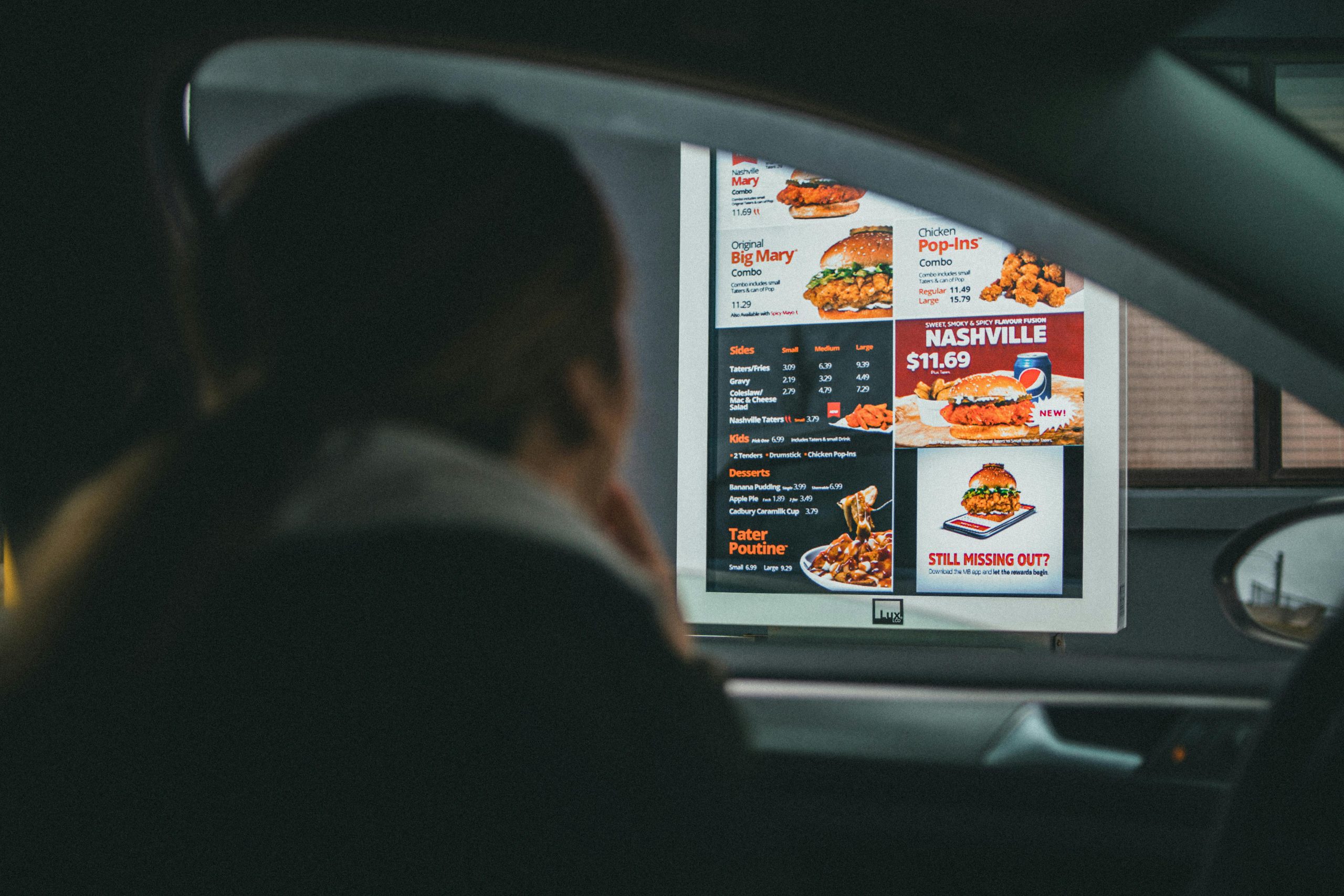
Recently, PR consultant Michael Schiferl placed his first drive-thru order via voice AI at a Wendy’s in suburban Chicago, and his experience wasn’t awful… just a bit off.
“As a customer, I found it odd that the AI tool didn’t prompt me with a ‘pull around,’ and I remember having to say, ‘that’s all I want’ to it,” Schiferl told FI, adding that it also asked him if he wanted medium or large fries when the combo he ordered included the small size.
“I couldn’t tell if it was a sneaky way to up the order or cost or just a standard ask,” he explained.
We humans have plenty of clumsy interactions with one another – from responding “You too!” to a waiter who said, “Enjoy your meal!” to forgetting to give a customer the ice cream she ordered and continuing to chat with her for several minutes before realizing why the exchange started to feel a little strange, which happened to me at a pop-up over the weekend.
However, this human-to-human sort of awkwardness is less unsettling to us because it’s familiar, which isn’t the case with voice AI, as the technology is still in its nascent stages.
And then there’s the ‘uncanny valley’ aspect. The term was coined by Japanese roboticist Masahiro Mori, who theorized that, as a robot becomes increasingly human-like, our affinity toward it rises – until it begins to feel almost too human, which can provoke feelings of discomfort or outright disgust.
I suspect that this phenomenon may explain at least some of the uneasiness that many consumers experience when interacting with a voice AI system.
In a survey conducted by Intouch Insight, 45% of respondents said they “didn’t like the idea” of using AI-enabled voice technology to automate QSR order-taking – and as you can imagine, the sentiment varies greatly among age groups. While 33% of respondents ages 18-44 reported “not liking the idea of AI,” the proportion increased to 54% for the 45 or older demographic.

A Need for Speed
The speed at which adoption of AI-driven technology has accelerated has likely contributed to much of the skepticism surrounding it.
Wendy’s recently announced plans to expand its Google Cloud-powered FreshAI platform to hundreds more restaurants following a successful pilot, with executives reporting that the technology had improved both the accuracy of orders and consistency of operations.
At the grand opening of Bojangles’ first Oklahoma location a few weeks ago, I asked Chef Michael Krimmer, senior director of menu and culinary innovation, about the customer response toward Bo-Linda, the chain’s bilingual voice-ordering system developed in collaboration with Hi Auto.
Despite the tool’s impressive order accuracy rate, which exceeds 96%, and its ability to reduce a drive-thru employee’s workload by approximately one-third, Krimmer said not every customer is on board with Bo-Linda taking their order just yet, which isn’t necessarily surprising, as humans are often resistant toward change, especially at first.
However, we humans don’t always know what we want. Krimmer feels that, ultimately, humans want to place their order with a friendly human who gets it right – but given the labor challenges plaguing the foodservice industry, these workers tend to be in short supply.
“The reality is that’s increasingly difficult to deliver consistently with human staffing alone, especially in high-volume environments. AI is simply filling that gap,” said Eric Lam, CEO of Berry AI.
Try Before You Decide
Patrick Gibbs, founder of the AI automation agency Epiphany Dynamics LLC, said that customer sentiment toward AI tools often shifts after deployment.
“Customers say they want a human but rate the AI experience higher when it works,” Gibbs told FI.
“The leading indicator I would watch is order-completion latency under peak load, not satisfaction scores in pre-deployment focus groups.”
In reality, consumers may actually value practical metrics like speed, accuracy, or a smooth ordering experience over human interaction – many are simply wary of the technology because it’s foreign.
That being said, experts also stressed that some of the early backlash toward voice AI may have been deserved due to poor implementation by the company.
Schiferl’s experience at Wendy’s, for instance, reflects some of the friction that persists, which restaurants must proactively address to avoid alienating their customer base – from unclear conversational cues to awkward pauses.
“The brands getting backlash are usually the ones that deployed before the recovery flow was solid, and customers are reacting to that specific bad experience, not to AI in principle,” Gurram said.
The Food Institute Podcast
At SIAL Canada 2026 in Montreal, Food Institute VP of Content and Insights Chris Campbell sat down with Mathieu Brisson, Global Sales Lead at Prestige Maple, to discuss how the company is transforming maple products for a rapidly evolving global food and beverage market.