In 2012, Kroger launched the first, nationwide premium private label known as Simple Truth.[1] And for years afterwards not much changed, even as premium private label unit sales steadily grew. Then, in 2024, Walmart launched Bettergoods at a furious pace while Target did nothing and has still not countered.[2] This is a massive acceleration signal for all of CPG retail.
Bettergoods is an “all-natural” brand like Simple Truth but one that uses an upscale modern positioning very new to the mass channel. When you compare it to the sugar-loaded, party sweets of Target’s Favorite Day or the highly processed offerings of Kroger’s Private Selection, the difference becomes crystal clear. Bettergoods has already reached 21% household penetration as of Feb ’25, is accruing over $500 million in annual sales with just ~400 UPCs (!) and commands a 46% repeat purchase rate.[3] It will become a $1 billion brand very quickly with KPIs like these.
Since the pandemic, the fastest growing segment of the private-label market has been the small premium tier; 76% growth from 2021 until the end of 2025 according to GlobalData.[4] In fact, premium private label sales grew twice as fast as total private label during this period.
With this kind of growth and Walmart’s aggressive entry, I get client questions routinely now, like:
- Is premium private label a modern foe or hidden ally to emerging premium name brands?
- Is premium private label competing for the same consumer as emerging brands or someone else?
- For self-manufactured emerging brands in growth mode, is it smart to service store label demand AND build a national brand or are you fighting for the same dollars? Or are you commoditizing your own innovation in doing so?
To answer these questions, we need to look at how private label makes its money for retailers, the role a premium offering plays for them, and the audiences attracted to a Liquid Death vs. a bettergoods protein pancake mix.
But first we need to understand where retailers still make most of their private label money.
Private Label’s Hidden Profit Center and The Enduring Power of Name Brands
Private label first appeared in supermarket chains as a way for retailers to offer discounts to price-sensitive shoppers all across the store AND to boost their own store profits in the process. Chain retail needs private label to keep the books in the black as much as they need slotting and other trade fees from manufacturers. And, for these reasons, most of the strategic store label volume remains in the price tier with the largest household audience: the value tier (e.g. Great Value, Equate, Good and Gather, etc.).
But we shoppers are incredibly unhelpful with retailers’ key objective here, because, when you look at unit share across the store, private label has always ‘won big’ in a very narrow subset of categories (e.g. fresh bakery, refrigerated meals, canned food, bottled water, packaged salads, shredded cheese, etc.). 35% of private-label unit sales are in just 20 categories![5]
Inversely, most consumers simply do not care about saving money in many of the most profitable, highly engineered CPG categories, because they do not believe the store label alternative could ever be an adequate substitute. The power of decades of marketing encourages this skepticism. Brands still own the profit pool of center store. For now.
In fact, some low-income shoppers are the most loyal name brand buyers, which is why ALDI now has name brands in virtually every category ‘set,’ including: Coke, Oreo, Lay’s, and the like. ALDI’s unit sales are now 22% name brand, despite its pure play store label brand image. See the embedded photo (below, at right) for an example of the new ALDI mix you may not be familiar with.[6]
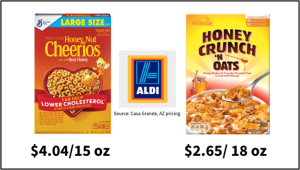
If ALDI has had to cave and bring in name brands, it’s less because of the R&D challenge and more because of the enduring power of iconic brands. Additionally, because store labels always want shoppers to recognize their mark across the store (and associate it with a discount on X quality tier), they cannot specialize in just one category like my emerging brand clients tend to do. They can never launch with a niche brand identity in just one category, something you would have to do to take on someone like Liquid Death directly.
Emerging name brands attach a cool factor, a modern symbolic pricing power in omni-channel mass retail that no store label can pull off (unless the retailer itself is bringing the cool, such as Erewhon in Los Angeles). To have real brand power that commands a price premium you must start as a category specialist. I wrote a book about this.
When the category itself is culturally new or new to older age cohorts, though, private label often grabs much more share, because name brand preferences are non-existent or weak in the bulk of the population (e.g. packaged salads, freeze-dried fruit, hummus, bottled water); largely, these are categories that were not part of America’s, middle-class weekly shopping ritual before the 1990s. This is one reason why bottled water is now the largest private-label category in terms of sheer units sold (over 3 billion annually!).[7] Half of today’s population grew up with zero bottled water brand preference (including me). And most of us still do not have a preferred brand in even younger, lower penetration categories like hummus, ginger shots or freeze-dried fruit.
What emerging categories point to is an amazing, counterintuitive opening for emerging brands to grow very fast: wherever name brands are weak market share defenders due to myriad cultural and market forces (e.g. refrigerated dough) or due to market share fragmentation among numerous brands over time (e.g. ice cream).
Private Label – Dominant Categories – A Founder’s Ironic Friend!
Regardless of the cultural forces driving high private label share in some categories, private label-dominant categories tend to be those where emerging brands have much less shelf space to find AND more competition from highly defensive name brand sales teams (think shredded cheese or sliced lunch meat). This seems a big disadvantage at first sight, but the beauty of these categories for founders is that established name brands and store label battle aggressively on price, shelf pace, price, shelf space and on and on. Name brands often stop innovating for large stretches of time (e.g. Oscar Mayer). This creates an amazing opening for founders. BUT you have to work twice as hard on your brand identity AND your product innovation if you want to capture meaningful dollars.
Where private label owns more than 50% of market share, the category is often new, and therefore emerging brands can command a premium with strong sensory innovation (e.g. Crispy Fruit in your local produce department). Private-label dominance (e.g. bottled water, canned goods, or freeze-dried fruit) does not equate to a low-price ceiling for emerging brands. Just the opposite. Often the average shopper has ‘lost the plot’ on innovation in the category and is more than ready to explore something new and interesting (or just some really cool branding). In addition, when private label ‘owns’ the category, a new brand needs a very high price per unit to outperform the unit economics of store label per foot of shelf space. In turn, this puts the right pressure on founders – enter with either compelling, premium priced innovation or superb brand marketing…or both! Or stay far away. 
Traditionally, entering private label-heavy categories relied entirely on product innovation and a ‘cute’ brand identity. Think of Tillamook slowly crawling toward scale since the early 2000s as Kraft tried every possible thing to slow it down. Futilely. Kraft could not compete with 15-month aged cheese produced at national scale; not profitable enough for Kraft’s finance team. It only took so long for Tillamook, because the company could not afford national advertising in the early years of its national push in the 2000s.
But, more recently, brands like Liquid Death used commoditized, private label heavy categories as a weak competition zone in which to launch a hyper-branded, entertainment brand. In fact, this is the entire thesis behind Science Inc, the venture capital firm who backed it originally. Again, in private label heavy categories, you can count on price being a massive driver of volume. So, this creates a large pool of upgradeable shoppers, in theory. But you better offer an amazing, branded experience to command a premium price at scale from anyone used to buying Safeway bottled water. And Liquid Death clearly achieved this.
Private label heavy categories are NOT a place to launch cheap knockoff brands. You probably won’t even get a meeting with any but the most slotting-fee hungry chain.
But, let’s face it, most emerging consumer brands have unwittingly picked name brand-heavy categories to compete in. Most founders live this reality. They may not hear about it directly from buyers, but in a bunch of these categories, adding facings to value tier private label vs. slots to founders of tiny emerging brands, is either more compelling financially or financially equivalent, even with your premium price. This is because a) newer brands are very low velocity and do not ‘produce’ penny profit fast enough and because b) emerging brands are more expensive for retailers to purchase per unit (because they generally enter the store via distributors who inflated list pricing well above the costs a retailer pays a co-manufacturers for private label product).
PL-Weak Categories – Premium Private Label is A More Clever Friend
Emerging brands tend to launch into categories oversupplied with both brands AND innovation. The ultimate reason for this is that founders are consumers themselves and grew up unconsciously thinking of specific categories as ‘branded’ and others much less so. These brand-heavy CPG categories are where their minds go when looking for opportunities or problems to solve. Most of these emerging ‘brands’ go nowhere, in part, because there are too much innovation and NOT enough marketing.
The irony for those slotting in to highly competitive, brand-driven categories is that emerging brands are vastly less well known than retailer brands. Re-selling slots is the primary financial game here, not supporting the average founder. The fees make more money than extra facings of slow-moving private label. You are competing with your emerging brand peers and with low market share legacy brands.
What many don’t discuss is how premium private label in brand-heavy categories like frozen pizza or cooking sauces helps validate emerging innovations in a category, validating them to a much broader audience who walk right by, noticing but not necessarily buying. The aggregate impact of premium private-label facings makes any retail chain look hip (or not). Premium private label is less a large profit bet by retailers than a brand-relevance machine, in every aisle, that funds itself; it is subsidized marketing to a large extent.
Premium private label also offers the same kind of relative discount as value-tier store label, just among a smaller subset of demand niches where, in specific zip codes, buy rate can be very high. If a retailer can secure a high buy rate of purchasing, driven by short purchase cycles, at a modest discount to premium name brands, premium private label generally strengthens that household’s traffic into the retailer.
This is what bettergoods is doing for Walmart. It is strengthening foot traffic and online sales among more educated households in America, especially college-educated Gen Z and Millennial households with children (where the scale of household grocery shopping peaks in terms of the life stage they’re in).
But doesn’t this make Walmart a competitor to a premium name brand in the same category? Isn’t Walmart undermining the same brands it brings in through programs like Open Call?
Well, not necessarily.
These photos below show how such a face-off looks in just three brand-heavy categories at Walmart. 
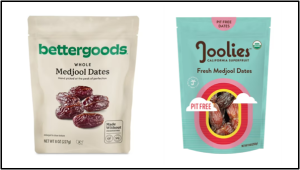
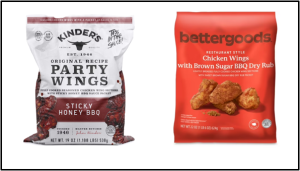
Bettergoods reveals its hipness well in these examples, but the speed of following the emerging brand innovator also matters. Premium private-label brands are getting faster and faster as premium private label becomes more and more critical to financially high-value foot traffic. And U.S. co-manufacturers’ growing unused capacity makes them more and more willing to work harder for new business. [8]
But what about the potential financial damage caused by premium private label? Is bettergoods hurting Chomps with its offering?
Well, when a specific household switches from an emerging premium brand to a premium private-label equivalent, my client work suggests the scope of any sales damage to the brand isn’t significant enough to change the brand’s trajectory. This is because premium private label is usually 5% or less of any category, if it exists at all. A strong emerging brand growing at 40-50% annually can and does quickly replace a premium private label ‘apostate’ with new fans. And, honestly, a founder does not want overly price-driven households influencing its balance sheet anyways. Let them go, I would say.
Premium private label does the most damage to stagnant, even dated, specialty brands that have failed to build a brand at all, that don’t create raving fans and don’t command a premium price from ordinary middle-class shoppers who were NOT trading up in the category beforehand. These weak premium brands cannot command a branded price premium, only a premium with a tiny audience moved by attribute-level product innovation alone. And these weak brands generally aren’t ‘emerging’ at all.
Additionally, you may notice that premium private-label UPCs carefully dodge the hero UPCs of major profit-generating emerging brands operating at scale. This is true in meat sticks, where bettergoods only knocks off Chomp’s smoked beef UPC, not its primary sellers. I would not be surprised to learn that Chomps is the manufacturer for bettergoods and steered them contractually away from their hero UPCs.
Whether premium or value tier, paying less for x quality tier is the immoveable core of all store label brand positionings. This means that brand preference isn’t a big variable, if someone is even browsing premium private label. They’re standing there for a deal on premium product innovation, but without the additional brand premium. The brand has already lost them at this point.
The price premium commanded by any name brand has been growing and growing since the pandemic. Numerator pegs the current name brand premium at roughly $2.10 per unit in a recent report.[9] In turn, our cereal comparison near the beginning of this article shows a typical private-label deal – a 50% discount off the name brand on a per ounce basis. A 100% price premium for a name brand adds up quickly in a basket for low-income households who only spend $320 per month on food.[10]
But, in premium private label I suspect the weighted average price premium per unit for the name brand is more like $3-4 a unit, as in the Chomps example above. There’s no third-party data tracked for premium private-label pricing, but my anecdotal selection of cases reveals a smaller premium price gap of 20-25% between premium name brands and premium private label. If true, this smaller premium private-label discount makes sense, because it’s harder to compress the pricing on premium goods with fundamentally higher COGS per unit than it is on Great Value saltine crackers.
If a household finds the need to get a premium product experience for less, often because they consume a LOT of it now, they’re elevating price above brand in the purchase hierarchy.
A brand that feels it is losing to premium private label is probably mistaken, but if it’s losing some sales, it is wasting energy reacting to this behavior and may have given up on its primary obligation to fuel word-of-mouth among fans and squeeze the bellows of marketing to make the brand fire explode. Ultimately, this is the best defense against any premium private-label threat in the early years of a business (when the damage might be material).
Key Takeaways
If you’re a high-growth emerging brand with technically insulated innovation, you shouldn’t only be unconcerned with premium private-label sales competition, you should also consider manufacturing store label for a top retailer so that you can capture that incremental audience who doesn’t care about brand, and only about modern product for a minimal price premium.
Remember that a powerful brand identity turned into a brand symbol in popular culture is the primary defense against commoditization by private-label forces at chain retailers. Fast-following premium private-label launches otherwise just tend to validate what you’re doing, especially if you make it for them.
About the author: Dr. Richardson is the founder of Premium Growth Solutions, a strategic planning consultancy for early-stage CPG brands. As a professionally trained cultural anthropologist turned business strategist, he has helped nearly 100 CPG brands with their strategic planning, including brands owned by Coca-Cola Venturing and Emerging Brands, The Hershey Company, General Mills, and Frito-Lay, as well as other emerging brands such as Once Upon a Farm, Rebel creamery, and June Shine kombucha.
Dr. Richardson is also the author of “Ramping Your Brand: How to Ride the Killer CPG Growth Curve,” a #1 Best-seller in Business Consulting on Amazon. He also hosts his podcast – Startup Confidential.
Footnotes:
- 1 Simple Truth did learn from regional brands like Publix’ Greenwise, however
- 2 Neither Good and Gather nor Favorite Day have a premium unit price positioning when I looked at them for this article
- 3 Numerator Private Label Perceptions Report – Spring 2025; Walmart.com; Apex Sales online case study
- 4 “Since 2021, the value tier has grown 35%, the mid-market tier 65% and the premium tier 76%. By focusing on innovation, store brands are more frequently seen as stand-alone labels that release new, on-trend items,” he said.”- Neil Saunders of GlobalData, quoted by Food Business News, Michael Costa, ‘The Power Behind Private Label Growth,” 11/20/2025
- 5 My calculation using unit sales total for 2025 and the top 20 F&B categories in PLMA’a 2025 State of Private Label Report
- 6 Numerator- Private label share based on total units sold at retailer; Source: Numerator Insights | 12M ending 3/31/26 vs. YA
- 7 PLMA Annual State of Private Label Report 2025
- 8 U.S. factories are running 33% below capacity according to KeyChain in its annual CPG manufacturing report, slide 4
- 9 Numerator Private Label Perceptions Study, 2025, Slide 12
- 10 2024 food at home expenditures, monthly analysis by the author from the latest available BLS data; 2025 data hasn’t been released
The Food Institute Podcast
In this episode of Food for Thought Leadership, Chris Campbell, George Hajjar, and Anna Kinder examine how consumers are adapting to mounting economic pressure, rising gas prices and shifting travel behaviors in 2026. From staycations and micro-vacations to scaled-back road trips and reduced air travel, the FI All-Stars explore how households are reevaluating spending while still searching for meaningful experiences and moments of indulgence.