If BJ’s Wholesale Club didn’t already exist, it seems incredibly unlikely that it could get off the ground. Few, if any, investors would be interested in risking capital on a business aiming to compete with Sam’s Club – operated by the company that revolutionized American retail – and Costco, whose roots date back to the business that established the warehouse/club model. (That was Price Club, founded in 1976, which merged with Costco in 1993.)
The idea that an upstart in the business could take – and keep – customers from two of the best retailers in the world would seem outlandish. Yet BJ’s has gone toe-to-toe with both Costco and Sam’s, and mostly held its own.
Since a 2018 initial public offering, BJ’s stock has provided total returns just over 300%.
That figure admittedly lags both Walmart and Costco shares over the same period, but not by much. And before a recent slide, BJ’s in fact had been a better long-term buy than Walmart (no small feat, given how well that stock had performed).
Revenue figures, too, show that BJ’s has competed well.
Total revenue growth since the IPO has topped that of Walmart (albeit with help from new locations). On same-store sales, BJ’s has lagged, but it’s still done reasonably well, with average annual growth over 4%. (Sam’s has posted an average of 6%, and Costco incredibly about 7%. All figures used in this article for all three companies exclude the impact of fuel prices.) And investors have responded accordingly: including debt, BJ’s now is worth about $12 billion, more than quadruple the $2.8 billion valuation it received in a private equity buyout back in 2011.
BJ’s Navigates Inflation, Tariffs, and Retail Rivalries
BJ’s performance has been all the more impressive given the nature of the club category, where supply is limited. Brands are careful about the precise products they put into the channel, in order to avoid potentially cannibalizing sales at traditional retailers and/or changing consumer perceptions of the brand. Exclusive and/or limited-time products are not uncommon. One would think suppliers would focus on the larger retailers as a result, yet BJ’s clearly has found a niche that enables it to keep pace in terms of merchandise as well.
But for the first time since the novel coronavirus pandemic arrived, investors are starting to wonder whether BJ’s is at risk of falling behind. Shares are down 26% from all-time highs reached in April 2025, and about 16% from brief highs reached in February. That includes a sell-off following fiscal first quarter earnings last week.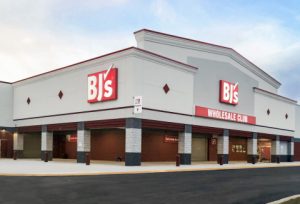
As with so many consumer-facing businesses at the moment, the concerns focus not just on the industry but the external environment. It’s not a coincidence that BJ’s has sold off from highs reached last April – just ahead of the “Liberation Day” tariffs – and then again this year after the start of military action in Iran. Even with tariffs (mostly) rescinded, higher fuel prices drive fears that the consumer will pull back.
BJ’s, which appears to aim slightly lower on the macroeconomic spectrum than Costco in particular, seems to be at risk. Certainly, investors are reacting as such: Costco stock has actually held up reasonably well of late. Its core audience skews more upper-middle-class and up, and so the company may actually benefit from higher fuel prices as even more affluent potential customers start to look to save.

Which retail stores are most successful in 2026?
The fact that even Walmart stock, which has been a juggernaut for a decade, has slipped since its own earnings report shows just how significant macroeconomic worries are. If Walmart is at risk, everyone is at risk. And quite obviously, that includes BJ’s.
But even before the spike in gasoline prices, there were signs of potential slippage on the competitive front. Over the last three fiscal years, same-store sales at BJ’s have grown an average of just 2.3%. Even a 6.5% print in fiscal 2022 (which ended January 2023) doesn’t look that impressive in the context of the spike in inflation that year. (Both Sam’s and Costco were over 10%, though Costco is on a different calendar.)
At the same time, Sam’s in particular clearly has improved its proposition to consumers. Its comparable sales growth averaged barely 2 percent in the last three years of the 2010s; the last three years, the average has been over 5 percent. Huge investments in the digital business have pushed the nameplate forward, and having Walmart’s backing obviously is an enormous edge in attracting both suppliers and customers.
The obvious retort to any worries is simple history. BJ’s has faced its two larger competitors for years, and managed through all sorts of macroeconomic environments. Yet it’s still established a clear niche and a nicely profitable (by retail standards) business. That track record would suggest that this, too, will pass. That may well be the case. But at the very least, what the market is telling us is that BJ’s has a lot less room for error than it did just a couple of years ago.
Vince Martin is an analyst and author whose work has appeared on multiple financial industry websites for more than a decade; he’s currently the lead writer for Wall Street & Main. As of this writing, he has no positions in any companies mentioned.
The Food Institute Podcast
In this episode of Food for Thought Leadership, Chris Campbell, George Hajjar, and Anna Kinder examine how consumers are adapting to mounting economic pressure, rising gas prices and shifting travel behaviors in 2026. From staycations and micro-vacations to scaled-back road trips and reduced air travel, the FI All-Stars explore how households are reevaluating spending while still searching for meaningful experiences and moments of indulgence.