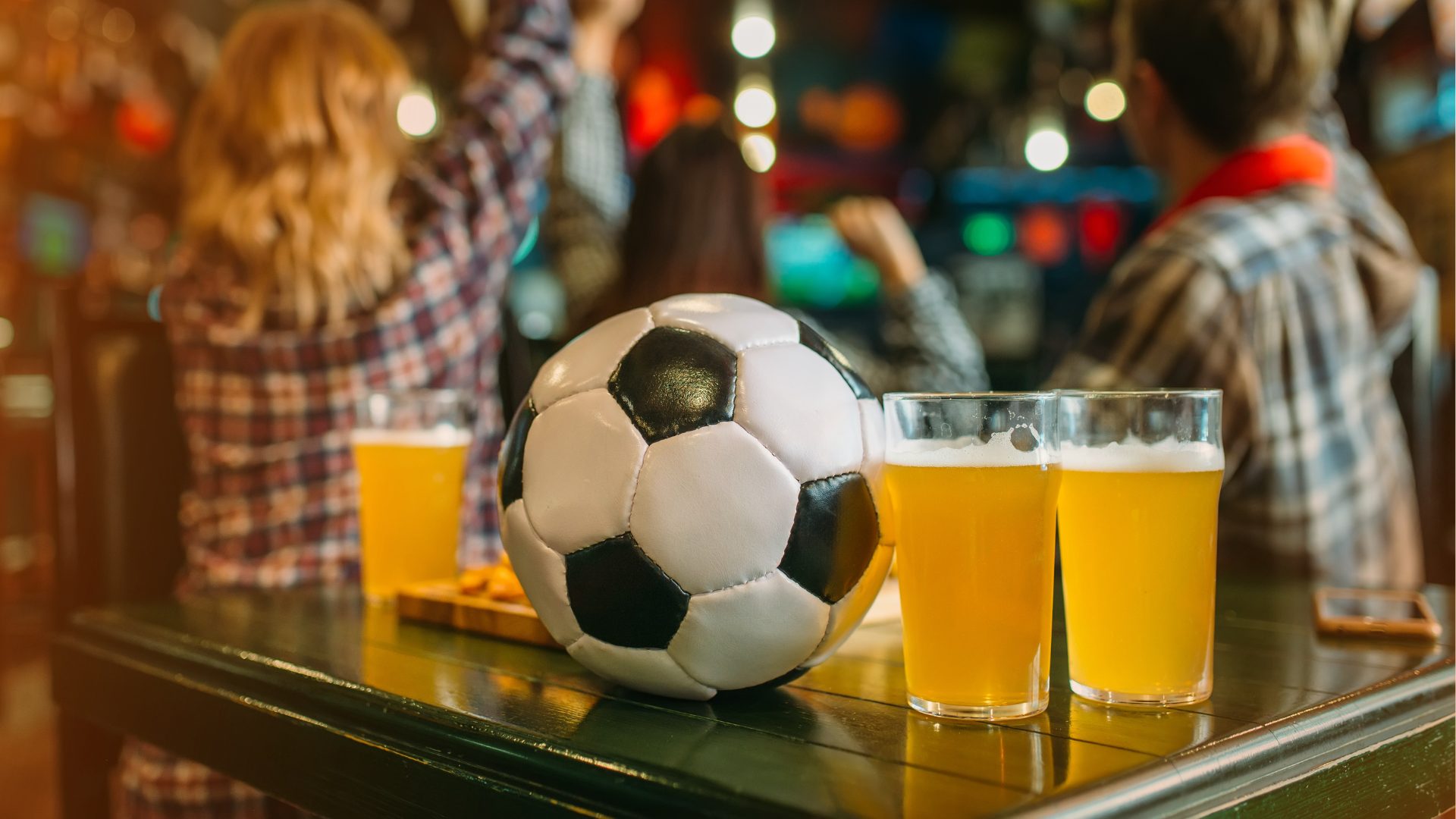
The most-watched global sports competition of the most-played global sport returns this summer – the World Cup, in which 48 international teams vie for glory across an entire continent. It’s football, “the beautiful game” (aka soccer, to the layperson) writ large across stadiums, streaming platforms, dive bars, sports bars, saloons, speakeasies, bistros, brewpubs, basements, taverns, taprooms, and pubs from Pennsylvania to Phnom-Penh.
And with it, great foaming pints, pitchers, glasses, steins, helmets, cans, and tallboys of beer. So, so much beer.
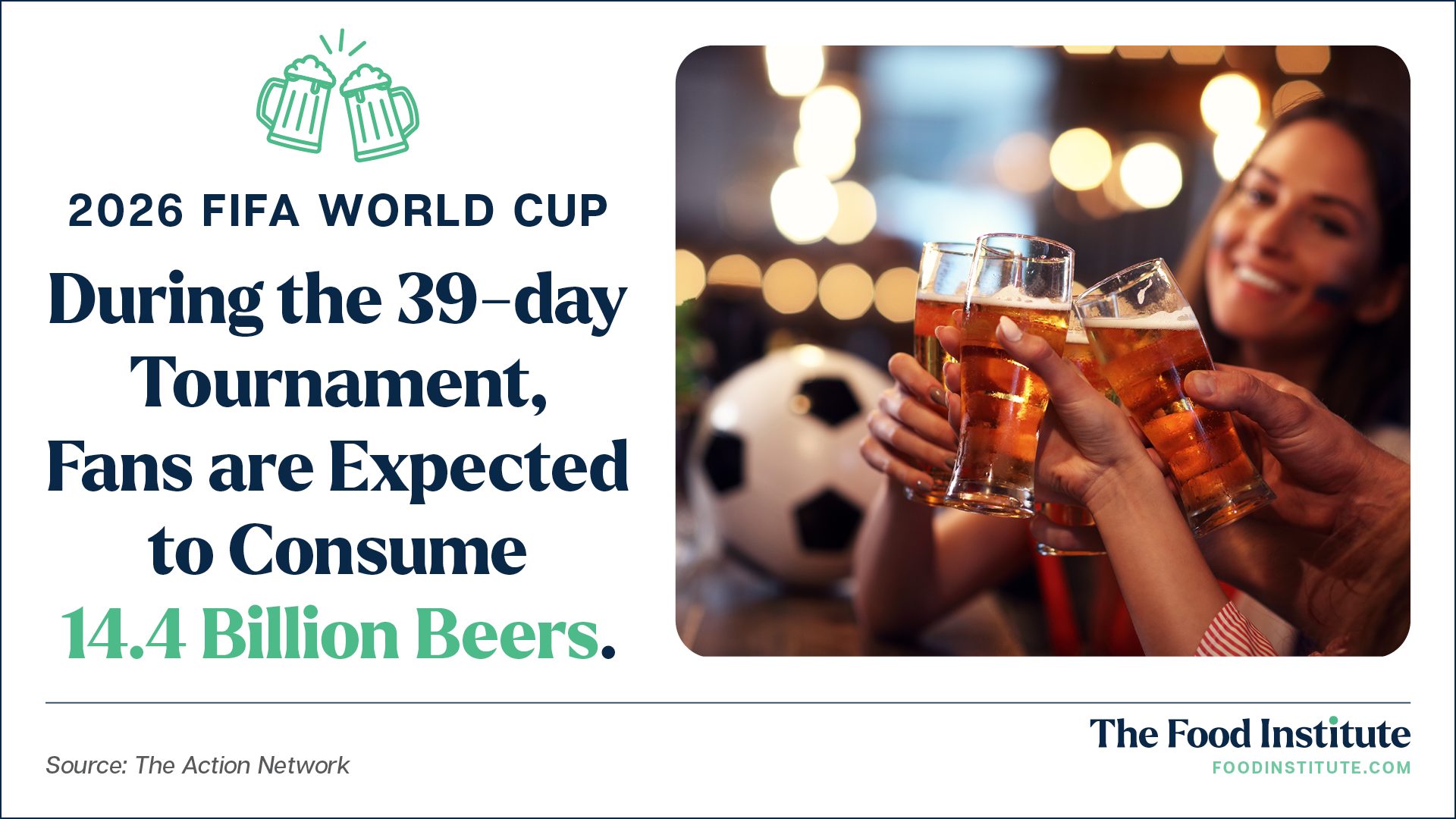
According to recent data from The Action Network, World Cup fans are expected to quaff more than 14.4 billion beers during the 39-day tournament. That’s over 1.8 billion gallons and roughly 369 million beers per day. The mind boggles – if the hooligans who imbibe this ocean of suds were to stack 16-oz. cups from the stadium turf, that cup snake would stretch to the moon (and back) three times. The moon is about 238,000 miles away; all told, that’s over 1.4 million miles of empties. That’s an entire economy of beer.
In other words, if you serve alcohol, these are encouraging numbers.
Beer Me
The lion’s share of World Cup beer consumption will occur in the U.S. (at least live). Sixteen host cities across three countries (the U.S., Canada, and Mexico) will host the tournament, and 11 of those cities are in the U.S. (Atlanta, Boston, Dallas, Houston, Kansas City, Los Angeles, Miami, New York/New Jersey, Philadelphia, San Francisco, and Seattle).

Most stadiums are accustomed to avid hometown fans rooting for their teams, painting their faces (“gotta support the team”), and generally enjoying themselves during game day; after all, if fans can afford tickets, they can afford beer. And afford beer they will:
The projected stadium revenue of beer sales alone for the World Cup is almost $128 million.
Plus, The Action Network estimates the U.S. will capture 88.6% of that sudsy share (about $113 million). But you don’t need to be a part of the stadium beer sales system to reap the benefits from the beautiful game in your own backyard.
According to Placer.ai, four major principles will inform the beer/football continuum this summer for World Cup host cities and the businesses equipped to take advantage:
- Major events drive meaningful audience shifts: Host stadiums are likely to experience distinct changes in visitor composition compared to the audiences drawn by typical events. In short, get ready for new and motivated fans who may not normally visit, say, AT&T Stadium in Arlington, Texas, home turf of the Dallas Cowboys.
- The stadium ecosystem presents a significant opportunity: Match-day activity is expected to extend beyond the venues, with stadium visitors and nearby fans driving incremental traffic to surrounding dining and entertainment. Nothing spills over like a global event of the most-watched, most-played sport in history.
- Host regions stand to gain from tourism and dining demand: Large-scale events tend to drive dining traffic and attract higher-income out-of-town visitors. From bougie stadium hoppers to those scrounging for a single World Cup ticket (and all the expense surrounding it), businesses can expect renewed foot traffic of every type, race, color, and creed (sporting their favorite football scarf, no doubt). Scarves up!
- Match-day impact will be felt nationwide: The World Cup’s broad appeal is likely to fuel increased visits to grocery stores, party-oriented dining chains, and sports bars. If you can’t get to the game, you can certainly host a watch party.
Of the eleven American cities slated for World Cup events, the top four cities are New York/New Jersey (the championship will be held at Metlife Stadium), Los Angeles, Dallas, and Houston.
This year, Spain and France are the overwhelming favorites to win the cup, though perennial contenders England, Brazil, and the ‘22 cup champion – Argentina (Lionel Messi’s home team) – cannot be counted out.
For American companies hosting World Cup matches or anywhere remotely close to these events, the international beer-buying contingent will be rampant; best to be prepared. Extra kegs. Extra staff. Extra promotions and pours to capture a fraction of that 14.4 billion mother lode of lager.
Some eschew football and the World Cup; some are jaded by modern sports; some just want to have a good time. Is football truly life, as Ted Lasso’s Dani Rojas says? Probably not, but it’s a great excuse to feel alive. And for savvy businesses, it’s a great excuse to open the taps, fill the stools, and raise a pint with your fellow fan.
Though maybe he’s onto something – the actor, Cristo Fernández, recently signed a professional contract with El Paso Locomotive FC. So, say it with me, whether you’re new to the beautiful game, a lifelong fan, or just want to dip a non-cleated toe into the 1.8 billion gallons of beer-soaked fun:
“¡OLE, OLE, OLE!”
The Food Institute Podcast
In this episode of Food for Thought Leadership, Chris Campbell, George Hajjar, and Anna Kinder examine how consumers are adapting to mounting economic pressure, rising gas prices and shifting travel behaviors in 2026. From staycations and micro-vacations to scaled-back road trips and reduced air travel, the FI All-Stars explore how households are reevaluating spending while still searching for meaningful experiences and moments of indulgence.