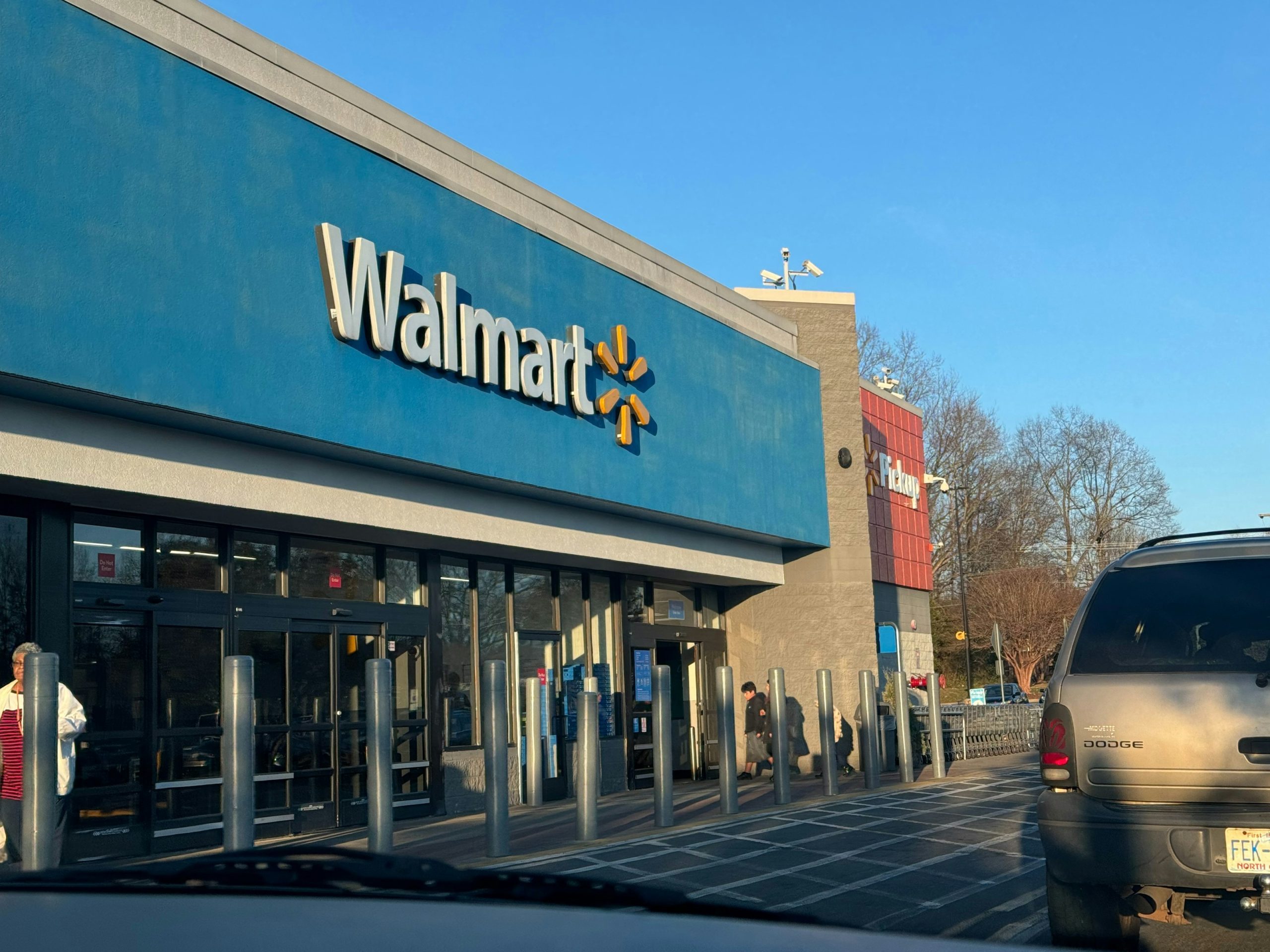
For years now, the core attribute of Walmart has seemed to be consistency in a world that has been incredibly volatile. In just a decade, American retail has been transformed by e-commerce, a pandemic has come and gone, inflation has spiked and moderated and spiked again. Tariffs have been placed (and paused, and placed, and struck down), wars have ended and begun.
Yet each quarter Walmart has, almost without fail, grown its revenue, improved its profits, taken share in both grocery and general merchandise – and increased its stock price.
Indeed, over the past decade, including dividends Walmart stock has returned just shy of 500%. That’s notably ahead of the Standard & Poor’s 500, an impressive achievement in a bull market. In the process, investor sentiment toward (and valuation of) Walmart’s business has changed dramatically. It’s easy to forget now, but ten years ago more than a few investors were worried that not only Amazon, but Target, were poised to erode Walmart’s market share in an omnichannel world.
Few observers have those worries anymore. But for the first time in some time, investors are showing at least a bit of concern.
Walmart Hit Shows Retail Still Isn’t Stable
After fiscal first quarter earnings last week, Walmart stock slid over 6%, its biggest single-day decline since the announcement of “Liberation Day” tariffs last year. Over the four trading sessions ending last Tuesday, Walmart stock fell more than 10%. That was, as financial magazine Barron’s noted, the stock’s worst such run in four years.
The question is whether investors are worried about Walmart itself, or about the external environment to which the company has seemed so impervious for so long. It’s almost certainly the latter.
While Target has shown signs of life of late – its stock is up more than 50% from November lows – its first quarter sales growth still was modestly behind that of its larger rival. Even with easier year-prior comparisons and in a quarter Target executives said was “well above expectations”, Walmart still is taking share.
That was hardly the only bit of good news from Walmart results. New CEO John Furner spent a chunk of the post-earnings conference call trumpeting his company’s accomplishments: success with the AI chatbot Sparky, a better first-party assortment online, an advertising business growing over 30% year-over-year in every market.
Indeed, from the numbers and the prepared remarks, the quarter seemed little different from Walmart earnings reports over the past ten years, most of which were well-received. But clearly there was enough to spook the market – and those fears seem to center on what’s coming in the second quarter and beyond, rather than what took place in Q1.
Most notably, Walmart is taking a big hit from fuel prices which have spiked since the beginning of the war in Iran.
Incredibly, CFO John David Rainey said on the call that Walmart had absorbed $175 million in fuel costs just for the company’s fulfillment operations. And, of course, that’s with the higher prices in place for only about 70% of the quarter. (Like most retailers, Walmart’s first quarter includes February, March, and April.)
Walmart Shields Shoppers While CPG Costs Climb
A hit of $175 million is manageable for Walmart – the company generated $7.5 billion in operating income in the quarter – and management framed the costs as a short-term hit taken for long-term customer growth.
In the post-pandemic era, Walmart has talked up its ability to capture higher-income customers by sticking to its core, bedrock principle of having the lowest price. As Rainey put it, “We continue to play offense. … We’re confident that this was the right approach to reinforce customer trust and support share gains over the long term.”
Clearly, the strategy is to keep customers that have abandoned traditional grocers and other rivals by not passing along temporarily higher costs. And it seems like the correct strategy, particularly because all but a few major competitors (Kroger, Target, and perhaps a chain like Albertsons) lack the scale and margins to similarly hold the line. (Another angle is that Walmart’s booming ad revenues and rising delivery fees also provide a source of high-margin revenue that can mostly offset these costs.)
But given how well Walmart has performed both as a business and a stock, it might be simply that the quarter reminded investors that significant competition remains, and that Walmart has to in some sense follow the same rules as its rivals. As strong as the business is, it’s not quite strong enough to simply pass along higher costs to customers to protect (or expand) its profit margins. This was proven true with tariffs (where Walmart too protected customers by absorbing much of the cost) and it appears true again with the spike in fuel prices.
In the broader context of the business, this is not a huge problem. Nothing in the quarter suggests that Walmart’s long-term trajectory has changed all that much. But much of the recent rally in Walmart stock likely was driven by investors looking forward to a time when the external environment wasn’t so volatile, and profits could be driven by the company’s long-term strategy, share gains, and advertising and subscription revenue.
What the recent earnings show is that such a time hasn’t yet arrived – and it looks like a few Walmart shareholders simply ran out of patience.
Vince Martin is an analyst and author whose work has appeared on multiple financial industry websites for more than a decade; he’s currently the lead writer for Wall Street & Main. As of this writing, he has no positions in any companies mentioned.
The Food Institute Podcast
At SIAL Canada 2026 in Montreal, Food Institute VP of Content and Insights Chris Campbell sat down with Mathieu Brisson, Global Sales Lead at Prestige Maple, to discuss how the company is transforming maple products for a rapidly evolving global food and beverage market.