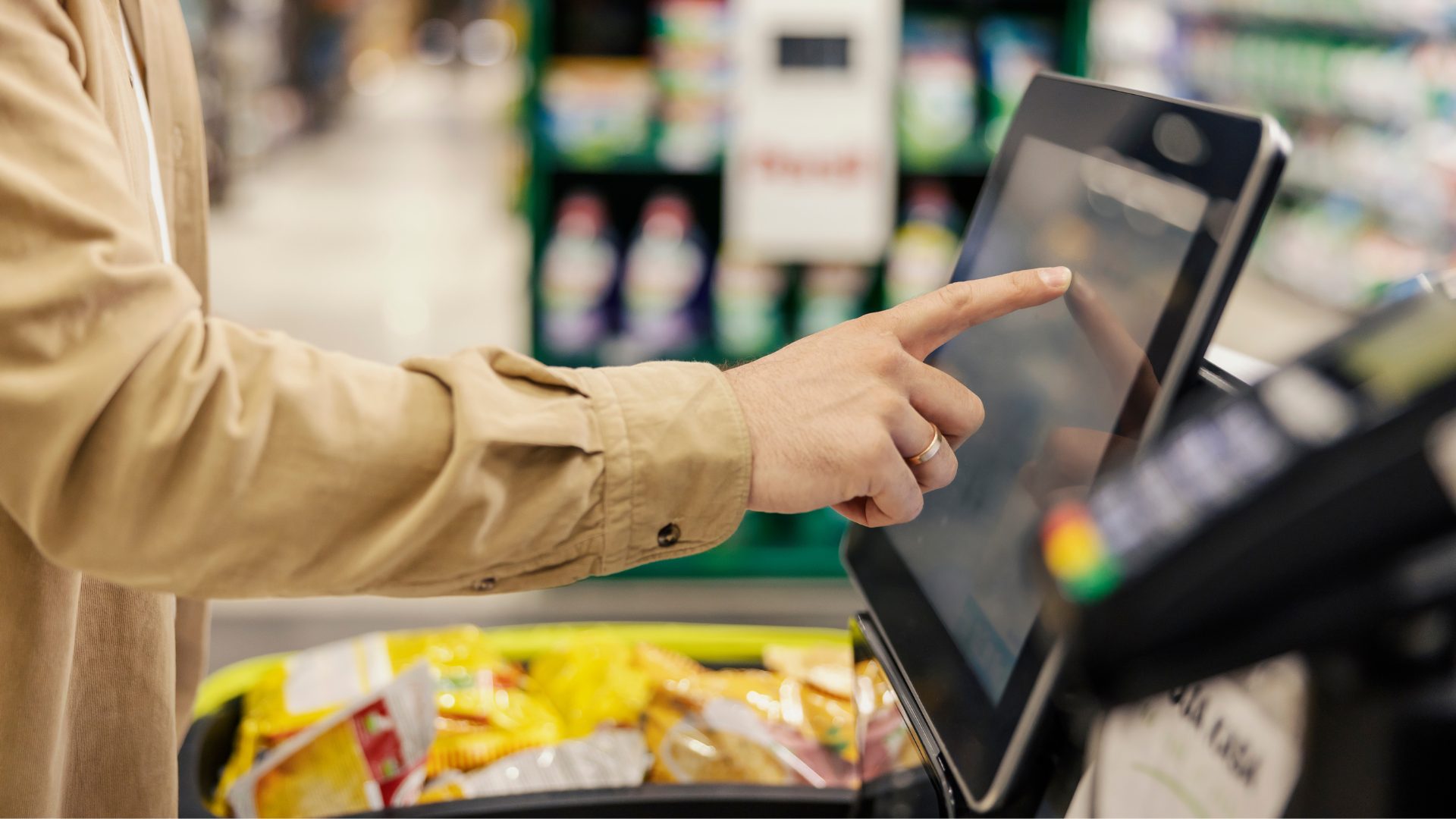
It’s long been said that as Walmart goes, so goes the industry. The world’s largest retailer is again putting that maxim to the test, with the deployment of digital shelf labels (DSLs) across its entire 5,212 U.S. store fleet by year’s end.
With roughly 2,300 of its flagship banner stores and Sam’s Club locations currently outfitted with DSLs, the significance of Walmart’s move to implement the industry’s single largest rollout of the technology cannot be overstated.
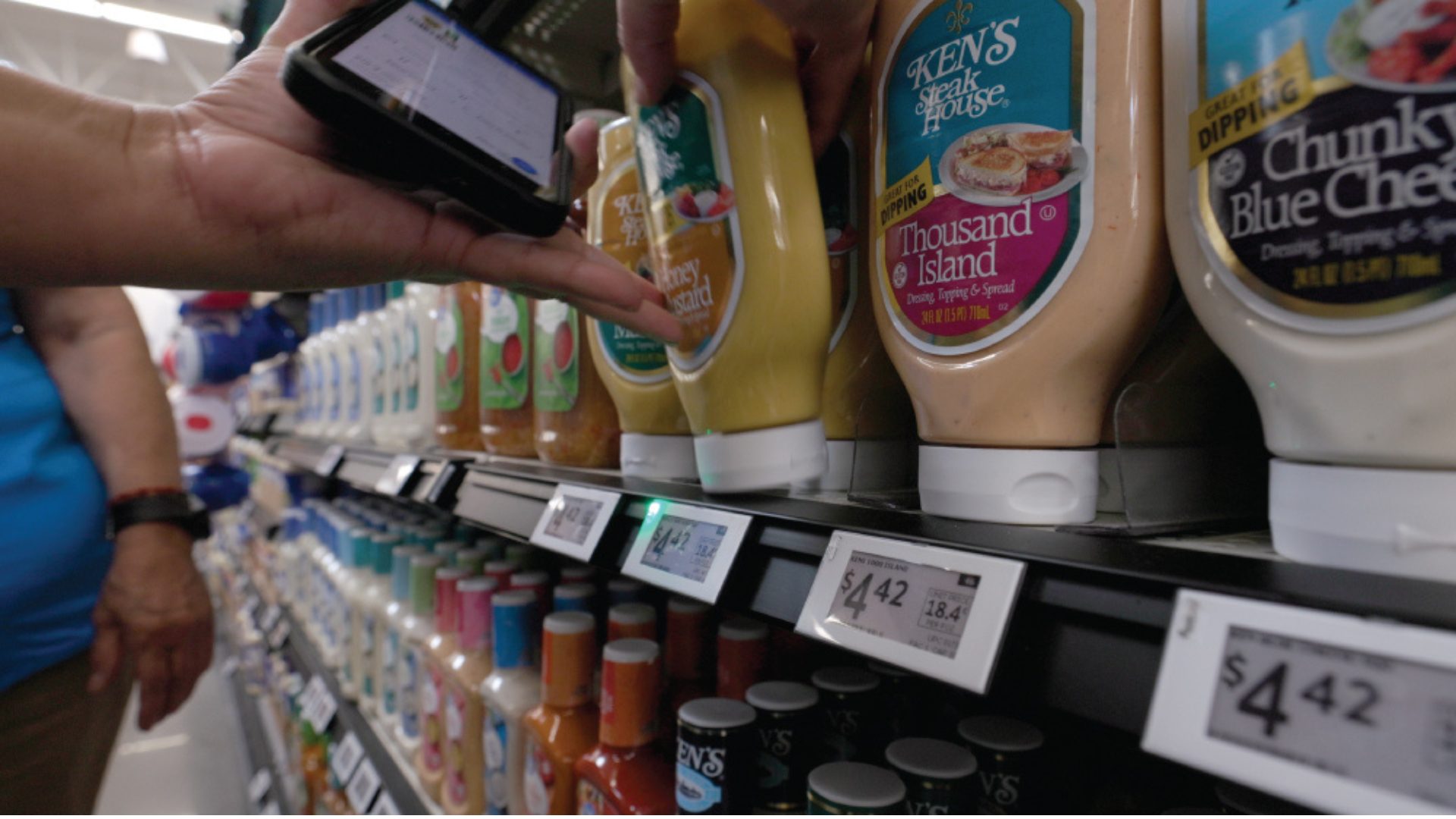
Beyond enabling associates to manage price changes through a centralized platform via a mobile app, Walmart’s store teams are also embracing adjacencies such as the “stock to” light feature, which allows them to trigger flashing LED indicators on items requiring attention, and the “pick to” light, which helps online fulfillment associates navigate aisles faster and pick products more accurately and efficiently.
Walmart has been deliberate in explaining that its DSLs, in partnership with its supplier partner Vusion, operate on a closed-loop system and thus don’t interact with shoppers, collect personal data, or serve any purpose beyond displaying prices clearly, accurately, and consistently while eliminating manual pricing updates that typically take hours, if not days, to complete. The retailer says the time savings provides store teams the opportunity to focus more on serving customers.
Other U.S. retailers moving toward ESL adoption include, but are not limited to:
- Aldi
- Lidl
- Target
- Schnucks
- Hy-Vee
It Used to Be Electric
DSLs – commonly known in the industry as ESLs (electronic shelf labels) – have been around for more than 30 years, originating in the early 1990s as basic LCD, calculator-style displays. Early adoption was slow, but the technology has evolved considerably from infrared-based systems in the 1990s to the advanced e-paper and radio-frequency displays used today.
While Walmart is using its clout to lead the DSL charge, a growing number of U.S. grocery retailers, including Kroger, H-E-B, Target, Whole Foods Market, Aldi, Lidl, Hy-Vee, and Schnucks, have also been testing and piloting digital tags with leading vendors such as Aperion as they move toward chainwide adoption. At the same time, labor unions, lawmakers, and consumer advocacy groups are leveling allegations of predatory pricing, shopper surveillance, and job losses.
With legislation now moving through 12 states and a federal bill (H.R. 4966), “Stop Price Gouging in Grocery Stores Act of 2026,” introduced in Congress in February, the industry finds itself at a pivotal moment.
DSL Déjà vu
When UPC barcodes replaced individual item price stickers in the 1980s, consumer advocacy groups and labor unions sounded nearly identical alarms: job losses, pricing manipulation, loss of transparency.
Today, those same barcodes are universally regarded as one of retail’s greatest efficiency and accuracy innovations.
“ESLs are on the same trajectory, and the industry needs to be prepared to make its case loudly,” said a retail executive who requested anonymity, adding that the real ESL story isn’t about “making arbitrary price changes, surveillance pricing or algorithmic gouging” but rather “operational liberation.”
For an industry that has long battled chronic labor shortages and razor-thin margins, that reallocation of labor isn’t a luxury – it’s an evolutionary survival strategy.
Some of the industry’s leading trade associations are actively helping members and stakeholders make the case for DSLs with their local lawmakers. FMI – The Food Industry Association and the National Retail Federation have both produced practical resources and fact sheets aimed at debunking misconceptions surrounding the technology.
“Grocers do not use DSLs to enable ‘surge pricing,’ surveillance-based pricing, or to set prices at all,” Michael Green, FMI’s director of state and local government relations, wrote in an early April blog post. Green also warned that banning DSLs would inevitably perpetuate wasteful, costly, and less accurate paper-based systems and that well-intentioned but misguided legislation based on hypothetical fears, rather than real-world problems, risks a range of unintended consequences.
With the debate certain to remain in the headlines, independent research from UC San Diego, the University of Texas, and Northwestern University found no correlation between ESL adoption and surge pricing. In fact, the studies found the opposite to be true: ESL adoption has been associated with more frequent discounts.
Looking ahead 30 years from now, it seems likely someone will write a story about the great ESL debate of 2026 the same way we look back at the controversy surrounding barcodes today with a mix of amusement and disbelief. The only variable is whether the industry will have spent those years on defense or on offense.
About the author: Meg Major is a food industry and retail expert with extensive experience working in content creation, B2B media, events, and industry relations. She has worked for the likes of NielsenIQ, Winsight, EnsembleIQ, and Progressive Grocer.
The Food Institute Podcast
This episode features Julie Chapon, CEO and co-founder of Yuka, the fast-growing app that helps consumers better understand the health impact of food and cosmetic products. Chapon shares the origin story of Yuka, which began as a personal mission to decode confusing food labels and has since expanded into a global platform with over 80 million users.