By now, most Americans know the “Love That Chicken from Popeyes” jingle well. But the fast-food chicken chain is facing the music, in essence, following five straight quarters of negative comparable sales.
Popeyes has experienced a noticeable slowdown in operating performance in recent years. Although the 54-year-old chain continues to generate higher total segment revenue, its underlying restaurant performance has weakened.
Let’s dig into the key data points:
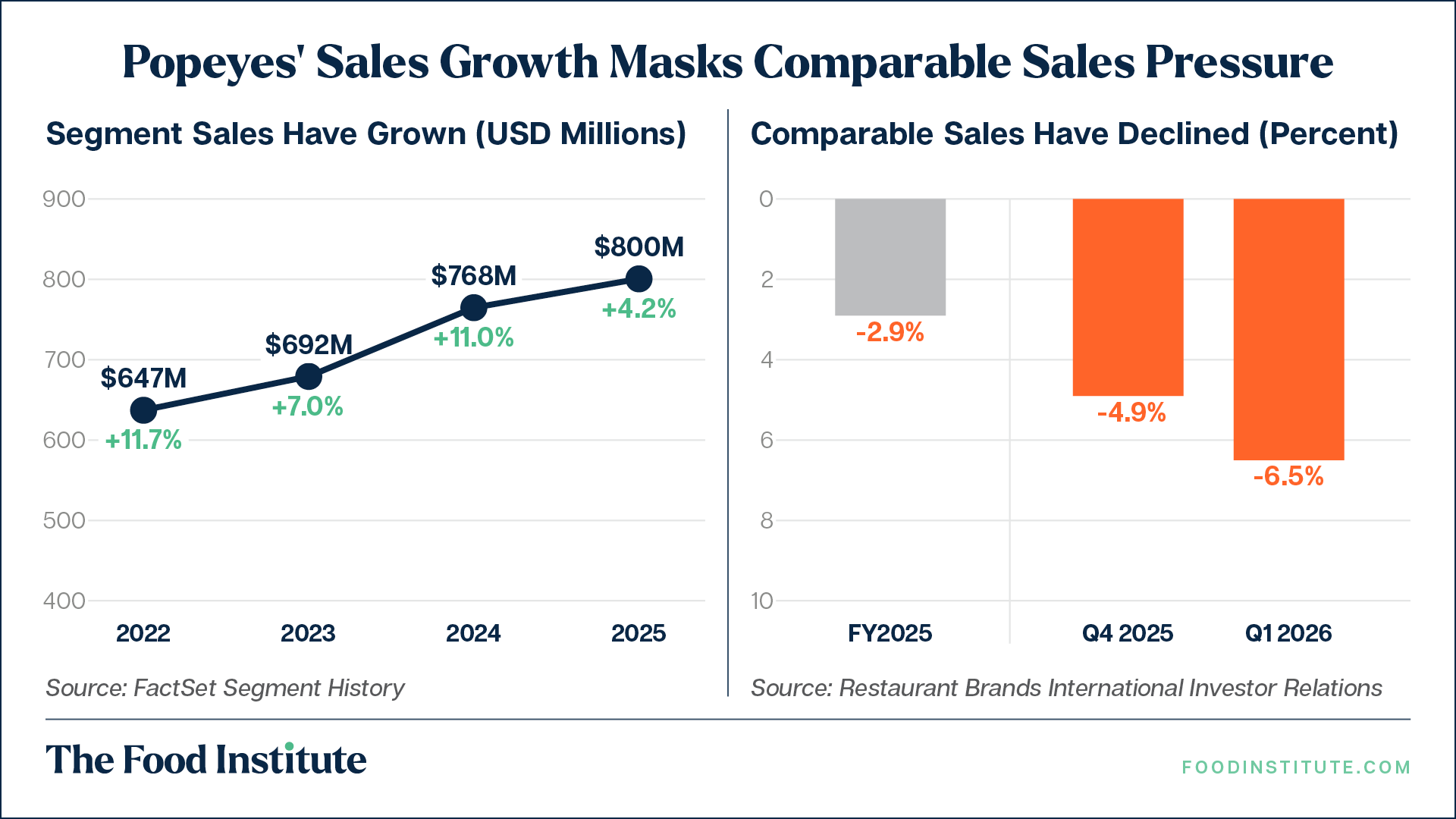
FactSet data show Popeyes’ segment revenue increased from $768 million in 2024 to approximately $800 million in 2025. However, parent company Restaurant Brands International (RBI) reported declining U.S. comparable sales of 2.9% in FY2025.

These findings suggest Popeyes isn’t in overall financial decline but is facing a sustained slowdown in its core operating performance.
Segment Revenue Continued to Increase
FactSet segment history indicates Popeyes’ reported segment sales have continued to grow, from $647 million in 2022 to approximately $800 million three years later.
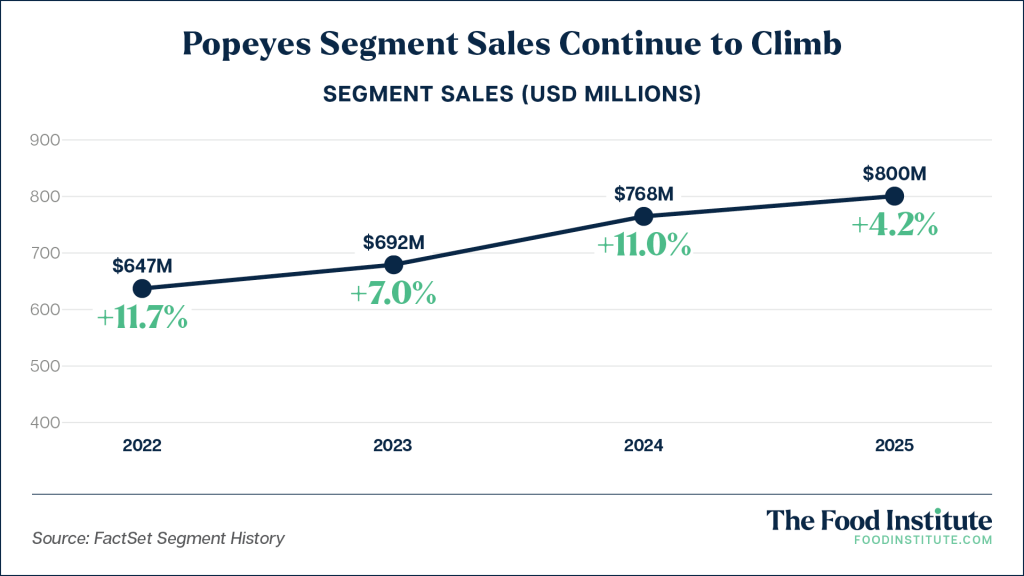
Although the chicken chain’s segment sales reached a record in 2025, the annual growth rate slowed to 4.2%, compared with 11.0% in 2024.
Comparable sales measure the performance of restaurants that have been open for at least one year and are widely considered one of the best indicators of underlying restaurant demand. RBI reported steadily decreasing U.S. performance in recent years, with comparable sales dipping -6.5% in Q1 2026.
The data show that comparable sales weakened throughout 2025 and continued to deteriorate into the first quarter of 2026.
RBI reported that Popeyes’ systemwide sales declined 3.9% year over year in Q1 2026. Systemwide sales reflect the total sales generated across the restaurant network. A decline in this metric suggests that weakness extended beyond individual mature restaurants during the quarter.
Why Segment Revenue and Comparable Sales Tell Different Stories
At first glance, FactSet’s segment revenue data appears inconsistent with RBI’s comparable sales figures. But it’s important to remember that the two metrics measure different aspects of the business.
Segment revenue includes franchise royalty revenue, company-operated restaurant revenue, advertising fund revenue, and revenue associated with network expansion.
Comparable sales measure sales generated by restaurants that have been open for no less than a year. As a result, total segment revenue can continue to increase even while existing restaurants generate lower sales. This is particularly common among franchise-heavy restaurant systems that continue opening new locations.
What’s Driving Popeyes’ Slowdown?
Based on RBI’s earnings commentary and industry reporting, management has identified key areas of focus as it works to improve performance: strengthening restaurant operations and execution, simplifying the menu, and boosting the brand’s value proposition.
Multiple reports have also pointed to increased competition within the QSR chicken category and a value-conscious consumer environment as factors affecting Popeyes’ performance.
Ultimately, the data related to Popeyes indicate that segment revenue continues to increase, revenue growth has slowed, and systemwide sales were negative in this year’s first quarter.
Popeyes’ recent performance brings to light a key distinction between revenue growth and operational health.
Although the chicken chain continues to grow revenue, sustained declines in comparable sales suggest that existing restaurants are underperforming. The brand is undergoing a period of operational weakness, particularly in its mature U.S. restaurant base.
Moving forward, a recovery in comparable sales will be a noteworthy indicator of whether RBI’s operational and value-focused initiatives are successfully restoring growth.
Food for Thought Leadership
Food retail is undergoing a fundamental transformation, and few people have a better vantage point than the SupermarketGuru Phil Lempert. In this episode of Food for Thought Leadership, Lempert joins FI’s Chris Campbell to discuss the forces reshaping grocery, from inflation and private label growth to changing consumer expectations around health, wellness, and transparency.