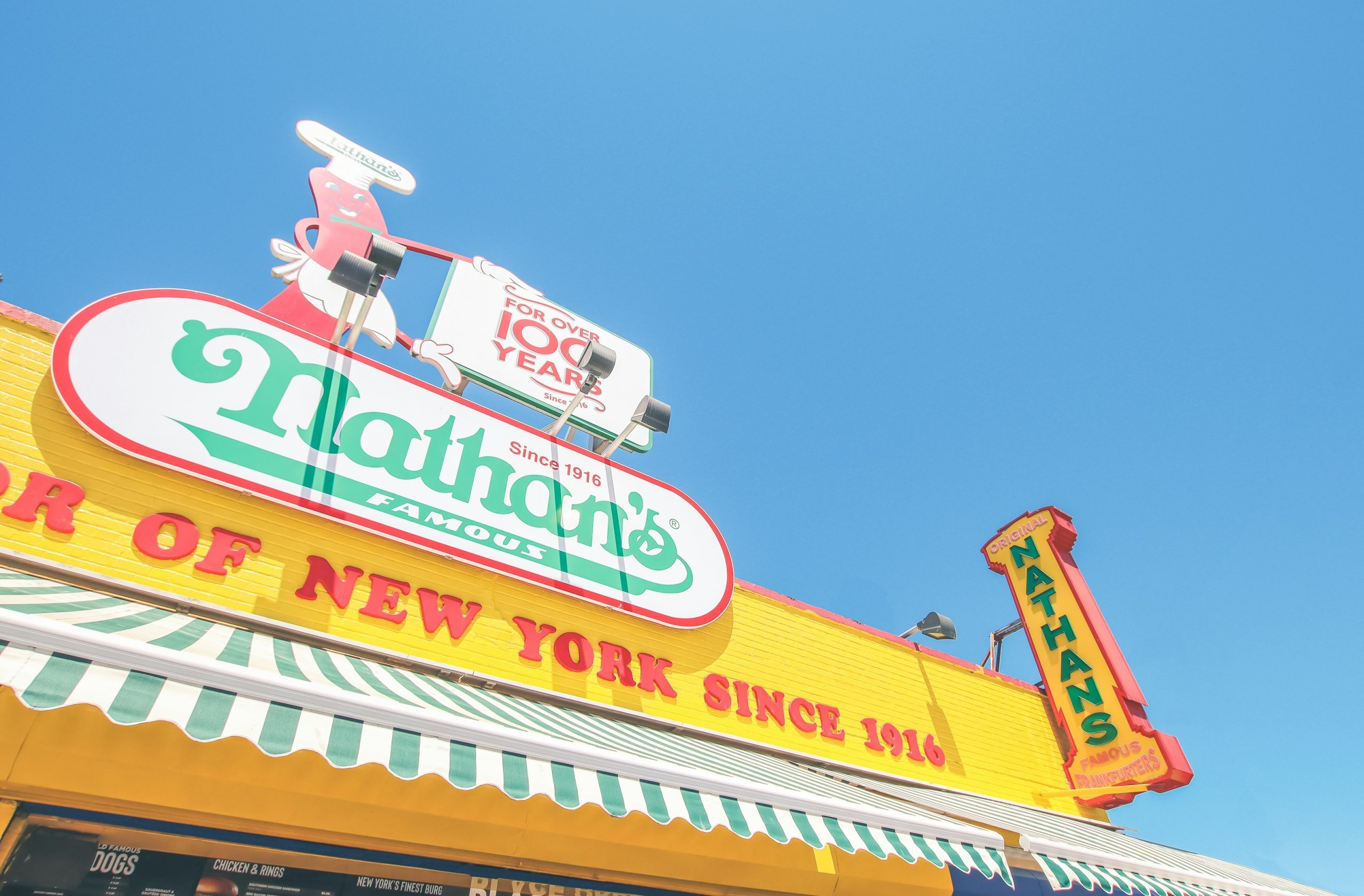
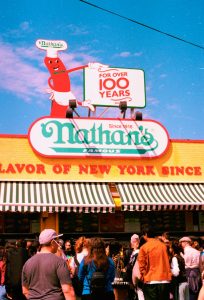
Every aspect of the Nathan’s Famous story seems utterly American. There’s the core product, of course: the hot dog, perhaps the most uniquely American food there is. There’s the origin story that’s so common to the nation: the company began with a single stand founded in 1916 by a Polish-Jewish immigrant, Nathan Handwerker.
Nathan’s son, Murray, led growth across the region, then the country, and eventually the globe: even now, Nathan’s Famous has restaurants in eleven countries outside the U.S. More than 100 years after its founding, Nathan’s is still well-known for its annual hot dog eating contest held at its original Coney Island location – on, of course, the Fourth of July.
What’s fascinating about the Nathan’s Famous story is that even the less well-known parts too are American – particularly the financial aspects. Nathan’s Famous became publicly traded in 1968, the goal for nearly every growing business in the U.S. In 1987, the company was acquired, becoming a small part of the leveraged buyout craze that, fueled by so-called ‘junk bonds’, targeted so many iconic American businesses at the time.
In 1993, the company went back to the public markets – but, by this time, it had become little more than a licensing business. That, too, was part of a shift by American companies to be “asset-light”. Franchisees ran nearly all the restaurants (though Nathan’s has kept ownership of the original stand, still an iconic part of the Coney Island boardwalk), and a partner manufactured the hot dogs. A lawsuit with that partner followed in the late 2000s (that, too, seems American).
Nathan’s lost the suit but wound up winning big: in 2014, it began a new agreement with John Morell, a unit of Smithfield Foods. Royalty rates shot up to over 10% of sales (against 3%-5% under the previous deal) and profits soared. Management followed another American trend: leverage.
Using the guaranteed revenue stream from the Morell deal (which had a term of twenty years), the company issued debt and gave the proceeds to shareholders. It took Nathan’s a few years to pay down those borrowings (which were much more expensive than the company had projected), and from that point it seemed like Nathan’s was ready for the final step in the evolution of the American company: selling out.
Nathan’s Deal Tests CPG Brand Loyalty
The most obvious suitor for Nathan’s was Smithfield, the company which was already driving essentially all of Nathan’s Famous profits. And though it took perhaps longer than many shareholders (myself included; I owned Nathan’s for several years leading up to the deal, fully expecting a sale) expected, eventually Smithfield came around. In January, the deal was announced, and Smithfield should take control in the near future.
For Smithfield, the acquisition seems like an exceptionally smart move. Ending the royalty payments alone (which totaled $33.6 million in Nathan’s fiscal 2026, which ended March 29) alone supports much of the $480 million cost of the acquisition (including the assumption of debt). Indeed, I personally was disappointed by the price Smithfield eventually paid, and I wasn’t alone: Nathan’s stock routinely traded over the eventual $102 per share offer for much of 2025.
Nathan’s also fits in perfectly with Smithfield’s strategy. The company of late has focused on moving into branded products, looking to boost profit margins on a business that at its core remains a commodity play. Nathan’s has one of the better brands in the space. It’s not clear exactly how profitable the business will be under Smithfield’s ownership (the financials of actually manufacturing the product were buried in Smithfield’s overall numbers), or what Smithfield plans to do with a restaurant chain that doesn’t really fit in.
Still, this was the kind of deal that investors predicted for years, because it made too much sense not to happen eventually.
That said, Smithfield also has brought on some challenges. There is political risk. Smithfield of course is a subsidiary of Hong Kong-based WH Group, which still owns 87% of the company even after Smithfield’s early 2025 initial public offering. It’s somewhat surprising that the acquisition of such an iconic American brand by a Chinese company (and a Chinese food company, no less) hasn’t made any ripples in the media or politics; it would not have been completely stunning if the deal became a political football or saw criticism from President Trump (like Nathan’s, a native New Yorker himself).
Even going forward, the idea that Nathan’s is now “Chinese” might influence some customers, particularly in a polarized social media age.
Can Nathan’s Outrun GLP-1 Headwinds?
The larger concern is more traditional: whether hot dogs can still be a growing business. Overall consumption appears to be stable in recent years, though data is imperfect. But in a world with GLP-1s and rising concern about additives, preservatives, and even sodium, it is possible that younger generations in particular start to avoid the product altogether.
To be sure, that broad concern isn’t new – nor has it affected Nathan’s all that much to this point.
Following the launch of its partnership with Smithfield, Nathan’s posted quite impressive results. Volumes in the company’s Branded Product Program, in which third parties like pretzel chain Auntie Anne’s, ballparks, and other venues, sell Nathan’s hot dogs, hit an all-time record in fiscal 2026, as it had the year before. Volumes in the retail business too have trended steadily higher since 2014.
Smithfield was able to increase Nathan’s distribution and, it appears, use better marketing and promotional strategies to drive growth in the channel.
China Deal Brings Nathan’s New Risks
The road ahead, particularly in eat-at-home, may be tougher. Distribution gains have largely come to an end: Nathan’s is sold essentially everywhere in the US that it can be sold. Pricing for what is a higher-end product in the category is a concern. In FY26, retail volume plunged 13%, with prices jumping 15%. Beef costs are obviously a huge factor in the price increases, and don’t show any near-term sign of abating.
There’s absolutely a scenario in which the ‘K-shaped economy’ further pressures retail demand: the higher-income Americans doing quite well at the moment perhaps are lighter consumers of hot dogs, meaning Nathan’s would see outsized effects from inflation and price pressures relative to even other categories in the supermarket.
Still, in over a decade together, Nathan’s and Smithfield managed to prosper in an environment that had its own set of challenges. That history is part of why a full merger made so much sense – even if Chinese ownership of such an American company added a new set of risks.
Indeed, surely Nathan Handwerker would have been stunned to know that, a century later, his business would be sold to a company from China. But globalization, too, has been as American as hot dogs.
Vince Martin is an analyst and author whose work has appeared on multiple financial industry websites for more than a decade; he’s currently the lead writer for Wall Street & Main. As of this writing, he has no positions in any companies mentioned.
The Food Institute Podcast
2026 may be the year of the GLP-1, but what are the risks to consumers who take this class of drugs? Suzy Badaracco, president of Culinary Tides Inc., explains the health risks associated with GLP-1 usage, and how the food industry can best serve this category of consumers.