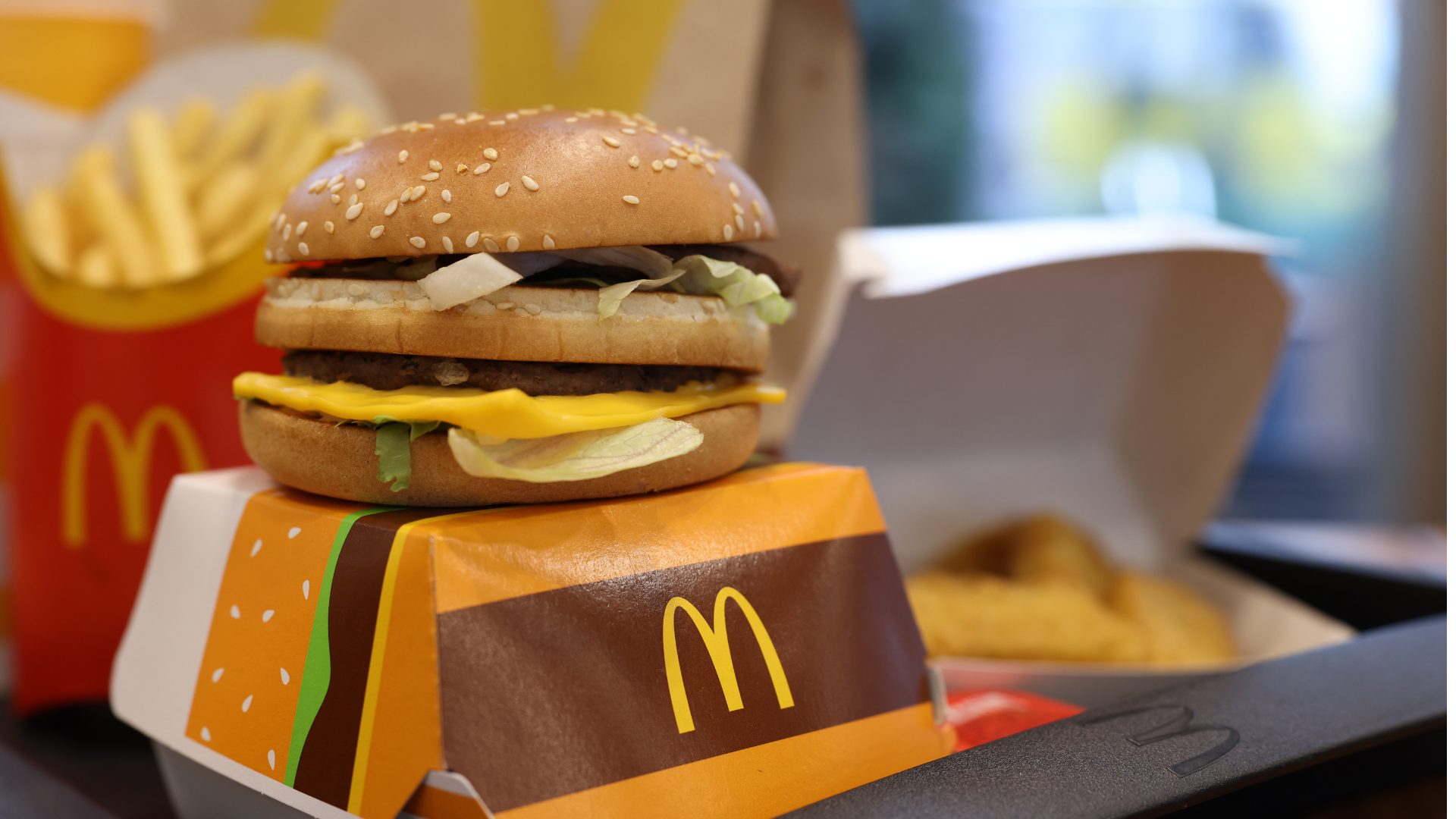
When inflation spiked in 2022, companies across the food industry took advantage. Major packaged food companies saw pricing contribute as much as 15 percentage points to revenue growth. In quick-service restaurants, the hikes weren’t quite as steep – but they were still significant. McDonald’s, for instance, seems to have taken about 6 points of pricing in the U.S. in each of 2022 and 2023.
In retrospect, most of these companies took too much advantage. After raising prices significantly, packaged foods companies have spent the last few years trying to win back customer trust and narrow the widened price gaps to private label competitors. (Not coincidentally, shares in many of those companies are at or near multi-year or even multi-decade lows.)
In quick-service, the damage wasn’t quite as significant — but it was noticeable.
McDonald’s, for instance, had to deal with viral complaints about the soaring price of its meals. Its own CEO would admit in 2024 that “our value leadership gap has recently shrunk”. Rising prices across QSRs opened a lane for competitors. The most successful entrant was Chili’s, which jump-started a long-dormant business by credibly promising restaurant-quality meals at only a modest premium to fast-food alternatives.
In response, the industry has pivoted back toward value – and in a big way.

Burger King Finds Its Footing with Value, Upgrades
Taco Bell has amplified its longstanding focus on lower price points. McDonald’s brought back the Extra Value Meal. Smaller chains have tried to keep up with their own value offerings.
And Restaurant Brands International’s Burger King, too, has aimed to capture more price-conscious customers, for instance, through its Duos (priced at $5) and Trios (priced at $7). For both the chain and the industry, it’s mostly been a rocky transition.
Burger King’s U.S. comparable system-wide sales grew just 1.6% last year and 1.2% the year before. That growth obviously lagged inflation, and appears to have come along with flat or even declining traffic, an industry-wide problem of late. In 2025, profits in company-owned restaurants declined, an issue given that RBI paid $1.4 billion for its largest franchisee only two years ago.
But in more recent results, Burger King is showing early signs of a turnaround.
RBI’s first-quarter earnings recently showed the chain posted an impressive 5.8% jump in U.S. same-store sales. What’s interesting, however, is that the improvement hasn’t come from competing solely on price.
Duos and Trios are working, and on the post-earnings call, management said pricing kids’ meals at $3.99 drove volumes. But executives also credited the redesign of the Whopper and a multi-year program of marketing and restaurant renovation as driving the outperformance relative to the industry. (RBI said Burger King outperformed peers by about five full percentage points.)
What Happens When Value Isn’t Backed by Quality
The need for value in terms of not just price, but quality and experience, isn’t surprising.
It’s becoming clear that in the current environment, fewer consumers view quick-service restaurants as inherently an attractive, low-cost proposition. They need a reason to visit.
Rival Wendy’s has learned this lesson, as its same-store sales have plunged even as the company has moved more aggressively into value offerings. Cheaper prices haven’t been enough, given that Wendy’s menu and its operations right now simply aren’t good enough.
Another RBI unit tells a similar story. While Burger King is rebounding, Popeyes is heading in the opposite direction. Same-store sales were negative in 2025 and plunged 6.5% in the first quarter, five percentage points worse than analysts expected. (It is exceptionally rare to see that kind of gap for such a well-covered business.)
With the chicken sandwich trend starting to fade and Popeyes as a whole losing buzz, simply offering a $5 menu isn’t going to drive traffic.
Obviously, the balance between offering low prices and giving customers more of what they want is always delicate, for restaurants of any kind. But Burger King and McDonald’s — which have combined their return to competing on price with new offerings, including drinks, and too saw solid first quarter results at home – at least for the moment seem to be getting that balance right.
Burger King and McDonald’s Find Wins
Struggling chains (and one could even expand the view toward a fast-casual space that has seen growth stall out) mostly made the same mistake in 2022-23 of ignoring price – only to perhaps overcorrect in recent quarters, and make price the only thing.
Customers want both quality and price, and chains need to understand how much of each they can deliver.
But the inability of some of the restaurant’s smaller players to find the right balance perhaps gets to a more existential question for the industry: how long can that balance reasonably hold? At the same time, consumers are demanding innovation and quality while pushing back on price, the cost side of the equation is getting more difficult by the day.
Rising gas prices are adding to cost inflation, while also dampening demand from lower-income customers. (McDonald’s stock is now down about 18% since the conflict in Iran broke out, a highly unusual move in such a short amount of time.) Labor is still tight and expensive; turnover remains a problem. Beef is at an all-time high. Franchisees who bear the brunt of these costs seem willing to go along with often-substantial changes in corporate strategy for now – but that may well change.
It’s as difficult an operating environment as the industry has seen in some time. And customers aren’t making it any easier. From that perspective, the surprise perhaps isn’t that many chains are struggling – it’s that Burger King and McDonald’s are still finding a way to win.
About the author: Vince Martin is an analyst and author whose work has appeared on multiple financial industry websites for more than a decade; he’s currently the lead writer for Wall Street & Main. As of this writing, he has no positions in any companies mentioned.
The Food Institute Podcast
At SIAL Canada 2026 in Montreal, Food Institute VP of Content and Insights Chris Campbell sat down with Mathieu Brisson, Global Sales Lead at Prestige Maple, to discuss how the company is transforming maple products for a rapidly evolving global food and beverage market.