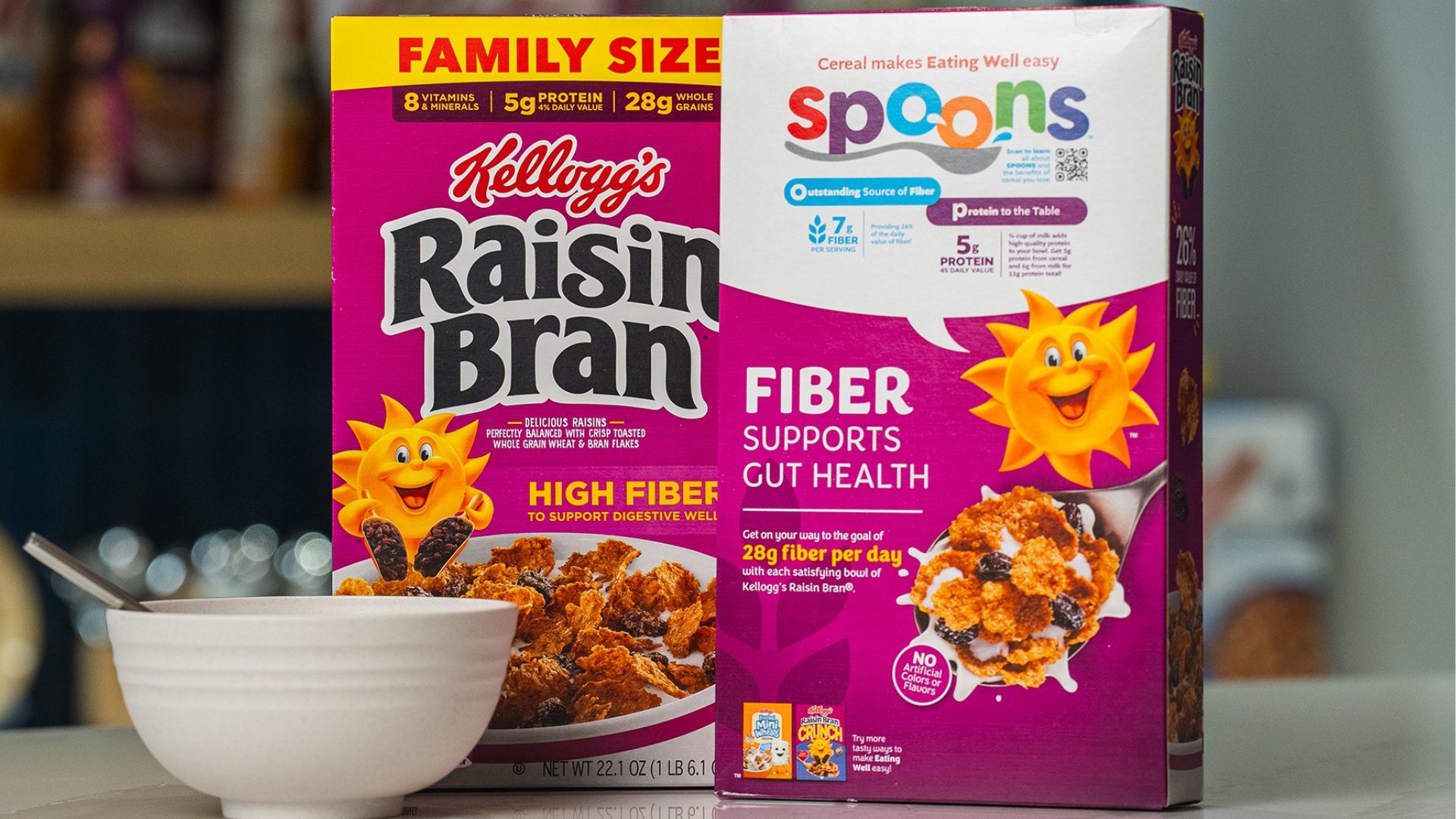
The cereal aisle has been transformed countless times since 1894, when the Kellogg family invented Corn Flakes in Battle Creek, Michigan. These days, grocery shoppers are as focused as ever on healthier items, and the latest move by WK Kellogg Co would make the likes of John Harvey Kellogg – a former superintendent of the Battle Creek Sanitarium – proud: the company has rolled out an on-pack nutrition initiative called “SPOONS.”
The on-pack labeling is meant to make it easier for consumers to choose cereals based on their nutritional priorities.

“Parents are navigating information overload. Ingredient lists are long, claims are complex – curation reduces decision fatigue,” Tarun Chandrasekhar, the CPO at Syndigo, told The Food Institute.
As a result, in the U.S., the back of most Kellogg cereals will now feature labeling based on the SPOONS acronym:
S – Simple ingredients
P – Protein
O – Outstanding fiber
O – Other nutritious foods
N – Nutrients you need (i.e. iron)
S – Single-digit sugars (i.e. 10g or less)
The nutritional labeling will appear on Kellogg’s products including Corn Flakes, All-Bran, Frosted Mini-Wheats, Raisin Bran, and Rice Krispies. The on-pack messaging and visual presentations were tested with consumers to ensure they could easily understand the information.
“We gained a great deal of consumer insight from the SPOONS work, including the fact that cereal eaters were surprised and excited by the simplicity, fiber content, and single-digit sugars of our cereals,” stated Sarah Ludmer, RD, the chief wellbeing and sustainable business officer at WK Kellogg Co.
“What Kellogg’s got right is making the framework scannable and specific – fiber grams, single-digit sugars, simple ingredients,” Stephen Ellsworth, a retail expert who once helped co-found poppi, told FI. “But more importantly, they’re focused on making foods people already know and love actually better for them.
“Consumers are tired of being sold a bill of goods,” Ellsworth added. “They’re demanding great-tasting products with ingredients they can feel good about, and that bar is only getting higher.
“This initiative can help re-educate shoppers, but at the end of the day, the product has to live up to the marketing — full stop.”
CPG Leaders Question Kellogg’s SPOONS Nutrition Play
SPOONS is part of WK Kellogg’s overall strategy to inspire growth within the $10 billion U.S. cereal category. The company said in its latest press release that cereal remains one of the most popular household staples, with 50 million boxes purchased each week.
That said, some industry insiders are skeptical that Kellogg’s latest initiative will make a significant impact.
“Kellogg’s new SPOONS on-pack guide is another attempt to reposition classic cereals around fiber, protein, and single-digit sugars, but I see it as mostly an attempt to stop shelf space erosion,” said Bradly Guldemond, the owner of CPG Guy. “The highlighted fiber is highly processed and not what diets lack, the sugars are still a lot despite being single-digit grams, and much of the protein content relies on the added milk.
“Consumers aren’t switching brands, they’re ditching cereal breakfasts altogether for higher-protein, lower-carb alternatives.”
With those challenges serving as a backdrop, WK Kellogg – which has added better-for-you brands like Kashi and Bear Naked in modern times – hopes to be disruptive in continuing to make cereal culturally relevant.
“This year we’ve really dialed up our marketing by leaning into fiber … launching SPOONS and introducing new innovations into our portfolio,” said Doug VanDeVelde, Kellogg’s chief growth officer. “As a newly private company we have a lot of runway to do big things and we are highly optimistic about the future of the category and our brands.”
The Food Institute Podcast
In this episode of Food for Thought Leadership, Chris Campbell, George Hajjar, and Anna Kinder examine how consumers are adapting to mounting economic pressure, rising gas prices and shifting travel behaviors in 2026. From staycations and micro-vacations to scaled-back road trips and reduced air travel, the FI All-Stars explore how households are reevaluating spending while still searching for meaningful experiences and moments of indulgence.