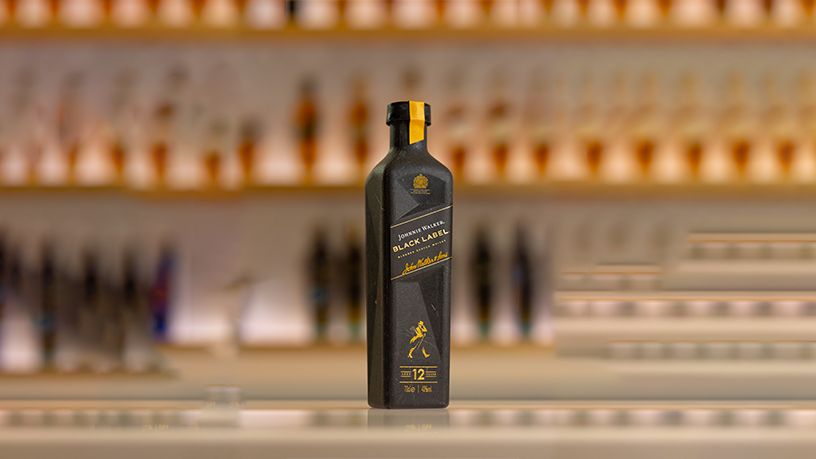
Recently, alcohol maker Diageo unveiled a bottle made from 90% paper for its Johnnie Walker Black Label whisky brand, which the company claims is around 60% lighter than glass alternatives – with almost half the CO2e.
A live consumer trial is currently underway to test the packaging innovation in “real-life conditions.”
This effort is being overseen by the Bottle Collective, which was launched in 2023 by PulPac and PA Consulting with the goal of creating a fiber-based bottle alternative to minimize the use of single-use plastic bottles in the food, drink, consumer health, and FMCG industries, with Diageo among its founding members.
The move reflects a similar endeavor from 2025, when Frugalpac launched a wine bottle made from 94% recycled fiber at Target in an effort to reduce its carbon emissions.
These initiatives come amid rising awareness of the health risks that microplastics pose to humans, animals, and the environment, which has increased consumer demand for eco-friendly packaging alternatives, such as packaging derived from upcycled citrus waste, and paved the way for further innovation in the F&B sector.

Let’s examine three cutting-edge packaging solutions beyond fiber.
1. Rice-Based Packaging
Kelly Dufour, director of marketing for chicken-stick brand Mighty Spark, emphasized the critical role that packaging plays to ensure the safety and integrity of shelf-stable meat products.
“Any defect in packaging, or packaging that is not completely airtight, destroys product and is unsellable. Because of this, we continue to use the best technology available, which is still plastic,” Dufour told FI.
However, the marketing expert stressed that her company is continuing to look for sustainable alternatives that maintain product integrity, with packaging made from rice being among the most promising solutions.
“Although it is not yet ready for mass production, we keep this (and other options) on the forefront of our innovation pipeline. We are always open to discussing sustainability and welcome ideas and feedback to continue pushing our category and industry in the right direction,” Dufour explained.
2. Polyhydroxyalkanoates (PHAs)
CJ Biomaterials is a manufacturer polyhydroxyalkanoates (PHAs), a class of polyesters produced via microbial fermentation, which are currently being used to develop biodegradable alternatives to plastic packaging.
Leah Ford, the company’s director of marketing and public affairs, says that PHAs were first discovered in the 1920s, but their potential as a sustainable packaging source had been largely overlooked until just recently.
“Biobased PHAs use renewable feedstocks, such as sugarcane, as a sustainable sugar source for the fermentation process,” Ford explained, noting that PHAs are distinct from other biobased plastics due to their versatility and environmental performance.
“Unlike fossil-based plastics commonly used for food packaging, PHA has a low carbon footprint and is third-party certified as both biodegradable and compostable in all environments, making it ideal for packaging that needs to comply with evolving waste legislation like Extended Producer Responsibility (EPR) laws and greenhouse gas emissions reporting,” Ford told FI.
The expert added that a “soft form” of PHA – amorphous PHA, or aPHA – is being used to create biodegradable, compostable food packaging film.
“In rigid thermoforms for food packaging and foodservice ware, adding aPHA to polylactic acid (PLA), another biobased, compostable biopolymer, improves the mechanical performance of neat PLA, increasing impact strength and toughness to levels that meet the specifications required for use in automated food packaging lines, while still maintaining transparency.”
According to Ford, this blend also maintains high levels of “certifiable biobased content” and can accelerate the composting process for PLA, giving packaging engineers a “broader range of thicknesses when designing packaging” while simultaneously giving way to “dramatic improvements in tear propagation resistance, puncture toughness, and tensile elongation relative to neat PLA.”
Ford elaborated that PHA is also available as a semi-crystalline polymer (scPHA) that’s suitable for applications requiring “greater stiffness and high-heat stability,” and it can either be used on its own or combined with aPHA to “better tune mechanical properties to a specific packaging or foodservice application.”
Packaging products that leverage these compounds include:
- Injection molded cutlery
- Coatings for paper cups and containers
- Drinking straws
3. Enzyme-Infused, Degradable Plastic
Bruvi, a single-serve coffee brand founded by coffee industry veteran Mel Elias, developed “B-Pods,” which the brand says are the first enzyme-infused plastic degradable coffee pods of their kind on the market.
Because the pods are infused with a bio-enzyme that allows them to break down rapidly in a landfill environment without leaving microplastics behind, they are designed to be tossed into the trash after use – no recycling required.
“Other coffee pods promote either recyclability or compostability, but the reality is that both of those options are largely ineffective,” a brand representative told FI, which reportedly streamlines the disposal process and “eliminates the need for additional recycling or composting infrastructure and carbon inefficient PLA or bioplastic solutions.”
Sustainable Packaging Challenges
Although the aforementioned solutions are intriguing, Stanislav Krykun, CEO at DST-Pack, which produces custom packaging for brands including F&B, told FI the biggest barrier to widespread adoption of sustainable packaging lies in scaling, not innovation.
“Making a prototype is one thing. Running millions of units consistently, with stable quality and reasonable cost, is a completely different story. Also, switching materials often means changing filling lines, logistics, even storage conditions. That’s expensive,” Krykun explained.
Ford agreed that scalability remains a major challenge, along with cost.
“The production of PHA is currently more expensive than traditional plastics, and there is a need for continued technological advancements to improve the economics of production.”
The Food Institute Podcast
In this episode of Food for Thought Leadership, Food Institute Chief Content Officer Kelly Beaton steps in as guest host to interview Fransmart CEO Dan Rowe on the evolving restaurant labor market. Rowe challenges operators to view labor not as a cost to minimize but as a strategic investment, noting that the most successful brands are those that “staff for the sales they want” and prioritize retention, engagement, and culture amid ongoing workforce constraints.