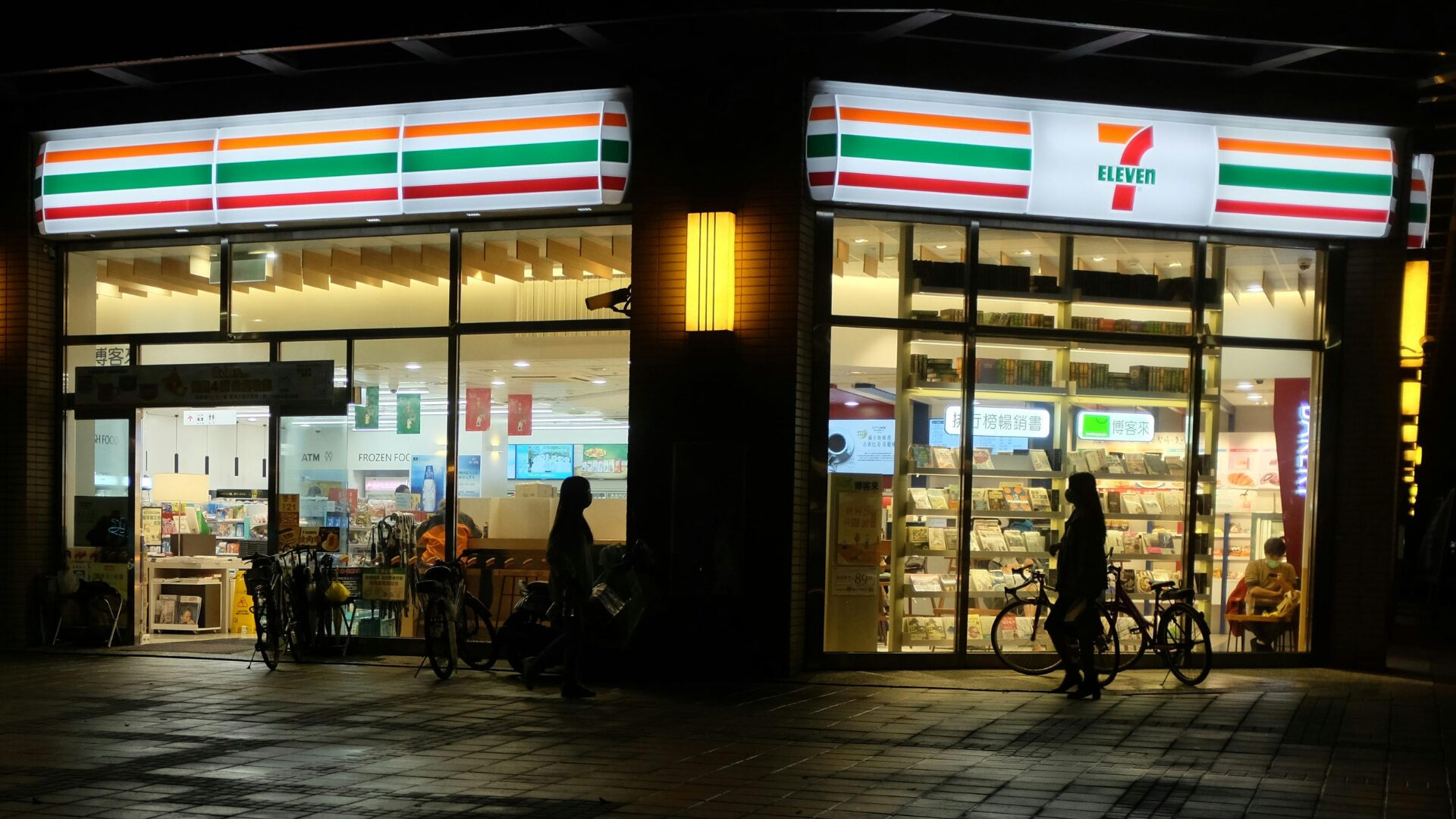
In August, Stephen Dacus, the recently appointed CEO of Seven & i Holdings, laid out a plan to transform his company. In less than five months atop the conglomerate and owner of the 7-Eleven chain in the U.S. and Japan, Dacus already had overseen significant change.
Earlier that year, Canada’s Alimentation Couche-Tard had given up on an attempt to buy out Seven & I, which would have been the biggest foreign takeover of a Japanese company in history. To calm investors, Dacus sold off a chunk of the business, including a supermarket chain, to private equity. And for the remaining convenience store business, Dacus laid out his plan for turning the business around.
And Seven & i and 7-Eleven both required a turnaround.
As Dacus noted early in his remarks, 7-Eleven remained the category leader – but being in first place, the CEO admitted, “can be a dangerous place to be”.
In the U.S., 7-Eleven (which Seven & i took full ownership of in 2005 after acquiring a majority stake in 1991) clearly was losing market share. The company’s own presentation noted stagnant profits in recent years. And Dacus described an essentially dysfunctional corporate structure, in which guidance from and oversight by the central office was inconsistent at best.

7‑Eleven Confronts Store Closures and Slowing Sales
As is the case for so many consumer-facing companies at the moment, inflation and a bifurcated economy were part of the C-store chain’s problem. Food manufacturers and distributors have called out weakness in the C-store channel for several quarters.
But other rivals clearly have managed the choppy environment. Publicly traded rival Casey’s General Stores, a convenience and fuel retailer in the Midwest, had more than doubled its net profit between fiscal 2020 (ending April) and fiscal 2025.
Meanwhile, private rivals were expanding at a rapid pace – faster than 7-Eleven itself, as Dacus pointed out. Sheetz, Wawa, and Buc-ee’s, among others, were not just adding locations but creating larger formats that competed as much with QSRs as with rival C-stores. Compared to those newer, larger stores with far broader offerings, 7-Eleven locations often seemed dated.
But after the departure of Couche-Tard – which claimed Seven & i simply never considered its buyout proposal in good faith, a claim Seven & i denied – Dacus needed to get 7-Eleven’s house in order quickly. The public reasoning for the board of directors’ rejection was that Seven & i could create more value on its own than through a sale. It was up to Dacus to prove that was indeed the case.
And it remains up to Dacus to do so.
Unquestionably, results early in the CEO’s tenure have disappointed. For the U.S. business, EBITDA (earnings before interest, taxes, depreciation and amortization) turned negative in fiscal 2025 (ending February 2026). Same-store sales were down modestly. Seven & i does expect improvement in 2026, with the forecast suggesting a 5% increase in profit. But even that growth rate, while a step in the right direction, is below the 7.5% annualized increases Dacus targeted over the second half of this decade.
And what’s more telling, perhaps, is that Seven & i’s biggest potential swing has been postponed. Dacus had forecast a U.S. IPO for 7-Eleven in the second half of this year. Alongside results last week, the company said the IPO was revised to fiscal 2027 “at the earliest”.
Another quiet disclosure surprised investors (and generated a fair amount of media coverage):
7-Eleven is closing 645 stores, with an unspecified amount transitioning to wholesale fuel outlets.
It’s worth noting that the closures don’t mean 7-Eleven is slimming down or retrenching. Overall store count is expected to grow throughout the decade.
Restaurant‑Style C‑Stores Gain Ground
7-Eleven simply needs to transform its fleet. It wants to add more restaurant-style locations, similar to the style of Pennsylvania-based Sheetz, which is steadily expanding into the Southeast and Midwest. Dacus is prioritizing better, fresher food as well as private-label options. Some current locations, it appears, simply aren’t a good fit for what the ‘new’ 7-Eleven will look like.
But in both the numbers and the strategy, the broad sense that comes from Dacus’s first year-plus in charge is that perhaps the turnaround he envisions is much larger, and more difficult, than he first realized.
Seven & i insisted after the fourth quarter that it’s committed to its multiyear targets. Yet those targets require massive change in store operations, at the corporate level, and in the very physical structure of the company’s locations.
The fact that roughly 5% of the current footprint isn’t fit for purpose doesn’t mean the entire chain is headed in the wrong direction, but it does show just how much work there is to do.
And that work is being executed amid a difficult macroeconomic backdrop, and against a number of well-financed, well-run, and fast-growing rivals. The size of the challenge and the need for near-perfect execution is highlighted by the very fact that Dacus was hired: he is the first non-Japanese leader of the company.
It’s the competitive aspect of the market, in particular, that’s so reminiscent of what has happened repeatedly in every American industry. The market leader or the market creator (and 7-Eleven is both; it essentially created the convenience store back in 1927) is always being challenged by rivals. The incumbent has the advantage of size, scale, and history – and quite often the challenge of a complacent, and overly bureaucratic culture that makes it difficult to adapt quickly enough.
As Dacus no doubt knows, many once-great American businesses have been in the position in which 7-Eleven finds itself now. His job is to keep his company from joining that list. And that job does not look easy.
Editor’s note: The other of this opinion piece, Vince Martin, is an analyst and author whose work has appeared on multiple financial industry websites for more than a decade; he’s currently the lead writer for Wall Street & Main. As of this writing, he has no positions in any companies mentioned.
The Food Institute Podcast
In this episode of Food for Thought Leadership, Food Institute Chief Content Officer Kelly Beaton steps in as guest host to interview Fransmart CEO Dan Rowe on the evolving restaurant labor market. Rowe challenges operators to view labor not as a cost to minimize but as a strategic investment, noting that the most successful brands are those that “staff for the sales they want” and prioritize retention, engagement, and culture amid ongoing workforce constraints.