Last year was pivotal for Amazon: it trialed store-within-a-store concepts in Whole Foods, tested ultra-fast delivery, and reorganized its grocery business’s leadership. This year, it’s starting strong with a tête-à-tête with Walmart on the big box concept, and it’s looking across the aisle for inspiration.
An internal memo recently leaked to Business Insider illustrated the e-commerce giant’s hypermarket dreams – supercenter warehouses, a new distribution layer codenamed “1DC,” and micro-fulfillment centers within Whole Foods stores.
The 1DC innovation reportedly leverages facilities that stock the most frequently purchased products to replenish space-constrained fulfillment centers, thus minimizing out-of-stocks efficiently. The report noted that, in doing so, Amazon will shift its supply chain strategy from a “push” system based on forecasts to a “pull” system that connects efforts between fulfillment centers and distribution centers. A document noted that the company planned to open 12 of these centers in 2025.

It’s Not All New
We’ve already seen some of these concepts. FI previously covered two separate trials of integrated fulfillment capabilities within Whole Foods locations in Pennsylvania and Chicago, which, at the time, were positioned as convenient solutions to keep cross-shoppers within the Whole Foods ecosystem while offering traditional brands that don’t fit Whole Foods guidelines.
While that use case remains true, they were secretly also proving out a way to expand their grocery reach. The strategy makes sense: like Target’s “hub-and-spoke” model, which treats retail locations as mini-fulfillment centers, Amazon would leverage existing retail space to increase e-commerce productivity and access.
At the top of the new year, Amazon also submitted plans for the 229,000-square-foot supercenter. Located outside Chicago, the retail industry evaluated the decision with interest.
“The site in question is our planned location for a new concept that we think customers will be excited about,” said an Amazon spokesperson in a statement. The facility also includes a section devoted to warehouse capabilities.
Bill Read, EVP of Retail Specialists, noted its similarities to a Costco Wholesale in a LinkedIn post published after the mockups hit the wire. Comparisons have also been made to Walmart U.S. footprints, which average 179,000 square feet.
The internal documents suggest that the warehouse innovations are designed specifically to compete with Walmart’s grocery delivery program, boasting four hours or less. It planned to launch five “sub-same day” delivery supercenters in 2025, opting for larger footprints to compete with Walmart’s selection.
Amazon’s Fight for Market Share
As grocery e-commerce continues to blossom as a viable food shopping endeavor, the major players are racing to gain market share before the segment plateaus. Walmart currently captures roughly 30.9% of the market, compared to Amazon’s 23.6% position, according to data from EMarketer.
Walmart has the edge, with 90% of the U.S. population living within 10 miles of a Walmart store, and 93% of households being able to shop with same-day delivery, a key offering for grocery e-commerce.
The comparison becomes more apparent when considering aggregated online and in-store grocery sales: Numerator found that Walmart accounted for 21%, while Amazon and Whole Foods oscillated around 1.6% each.
Considering Amazon’s comparatively modest retail presence, the fact that it maintains a meaningful stake in the market suggests that it’s well-equipped to capture more market share. That is, if it can find its footing in the space.
In 2025, CEO Andy Jassy said he was “very bullish” about his grocery strategy, exercising more confidence in its plan as it integrates its efforts into its successful specialty arm, Whole Foods, which it acquired in 2017 for nearly $14 billion.
The internal documents show an aggressive picture of Jassy’s plan, and it’s logically sound, and compelling.
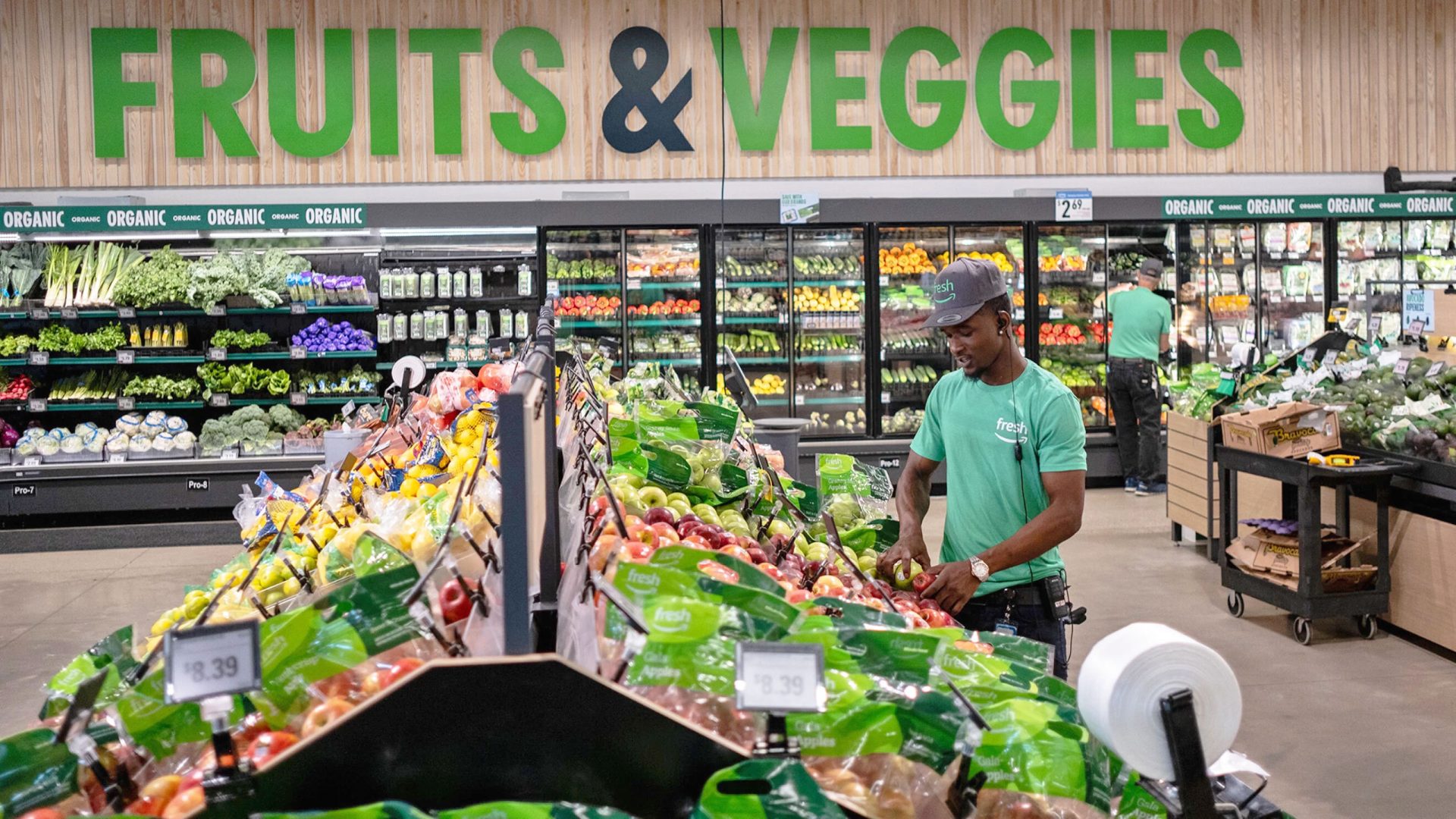
In general, Amazon excels at supply chain efficiency, speed of service, and assortment capabilities. With its latest strategy, it’s applying this bread-and-butter model to its grocery business, which previous attempts in the space have failed to do, with operations such as Amazon Fresh and Amazon Go.
This year is bound to be a big one for the e-commerce giant.
Beyond the U.S., internal documents show that Amazon is planning to bring the supercenter model to Europe, under an initiative dubbed Project Taylor. Additionally, it indicated interest in piloting ultrafast delivery in London this year.
Food for Thought Leadership
It’s undeniable that restaurants were challenged heavily in 2025, but what does that mean for 2026? Foodservice industry veteran John Inwright discusses the prospects for a new year, what’s working for successful operators, and the headwinds and tailwinds that could define the year.