As the government works on a formal definition of ultra-processed foods (UPF), WISEcode is taking the problem into its own hands, leveraging novel technologies to simplify UPF detection.
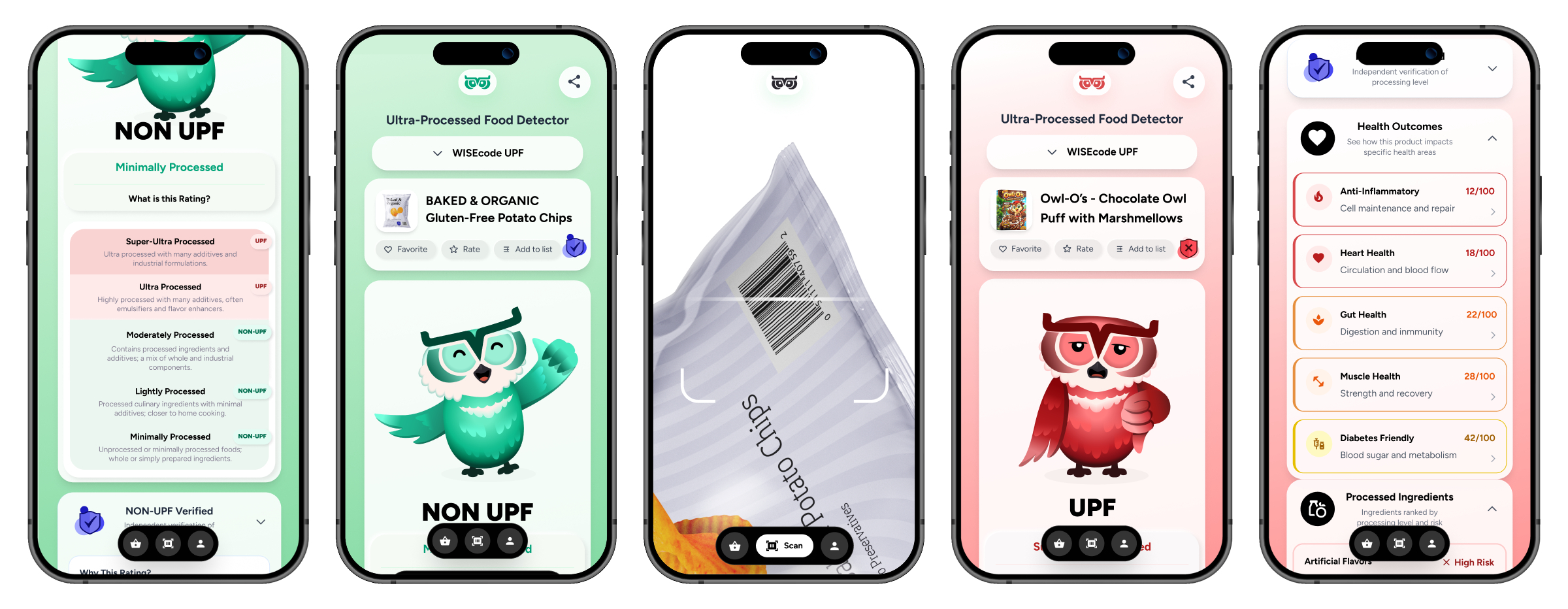
At Expo West, the startup debuted Non-UPF Shield, a digital verification program for brands, as well as a consumer-facing mobile app to help consumers understand if products are ultra-processed.
“Retailers, in some cases, don’t even know what’s on their shelves. … The consumer needs to have a scientific degree to read ingredients. That’s where we come in,” Chris Knoch, chief product officer at WISEcode, told FI in an interview.
WISEcode’s platform analyzes more than 840,000 packaged food products across 15,000 attributes, offering a nuanced approach to UPF discovery.

The UPF Problem
UPFs are top of mind right now. They make up nearly 75% of the U.S. food supply. As a result, consumers want insight into whether the foods they consume contain potentially hazardous additives.
Roughly 50% of shoppers and 79% of health-focused consumers are worried about the food ingredients that go into their favorite food and beverage products, according to recent Acosta Group research. Moreover, 78% of parents say processed foods pose a threat to children’s health, and 82% want to see government regulations on UPFs, according to KFF.
Originally derived from the Nova food classification system, ultra-processed foods have historically been clumped into four categories:
- Unprocessed/minimally processed products, e.g., fruits, vegetables, or milk
- Processed culinary ingredients, e.g., butter or sugar
- Traditionally processed foods, e.g., jam or canned fish
- Ultra-processed foods, e.g., shelf-stable cookies, sliced bread, or hot dogs
Various studies, however, suggest this framework eschews the positive food science involved with packaged food processing. It’s why a potato chip could be classified alongside a meat alternative, or a soda could be categorized alongside a bread loaf.
Back in 2021, a team of researchers associated with the University of Sao Paolo in Brazil suggested that the approach neglected well-established food science concepts. More recently, Cambridge University Press published a paper from Jimmy Chun Yu Louie, PhD., on the system.
“The binary nature of NOVA’s classification fails to account for nutritional composition, fortification benefits, and cultural food traditions, creating inconsistencies in categorization across different contexts,” he said.
WISEcode, on the other hand, classifies UPF consumption risk on a sliding scale, rather than a binary system, allowing for nuance to be recognized and taught to consumers.
WISEcode’s Approach
Quite a few UPF verifications have recently hit the market to give consumers transparency into grocery offerings. The Non-UPF Program and the Non-UPF Project represent two such endeavors, which both acknowledge that “processing” isn’t necessarily harmful.
Both solutions offer a voluntary, third-party review process with strict guidelines to claim the UPF-free certifications.
WISEcode, however, represents an automated process built on a data platform and ingredient database to determine UPF presence. Through this process, products are classified across five levels: Minimal, Light, Moderate, Ultra, or Super-Ultra Processed. As classifications near the latter side of the spectrum, more additives, emulsifiers, and industrially processed ingredients are incorporated into the formulation.
The app also displays contextual summaries to understand processing practices and ingredient implications.
“Consumers need clarity. Brands need consistency. Our Standard was built to support both,” said Peter Castleman, founder and CEO of WISEcode, in a statement.
Effectively, this equips consumers with more information regarding the products they do eat without the brands behind the products needing to be involved.
For products not in the database, Knoch told FI that consumers only have to scan the SKU and send it to the in-app AI agent to analyze the ingredient list. This analysis, however, will only be “verified” upon voluntary review from the product’s brand.
The Larger Issue: What Is Ultra-Processed Anyway?
This represents a larger industry shift towards transparency and clean labels. Non-GMO, Organic (and regenerative organic), Rainforest Alliance Certified, and Fair Trade all provide context into the food and beverage products in the supply.
Recent ultra-processed certifications operate similarly. However, the topic is a bit more difficult to pin down. Namely, the simple questions ‘what is an ultra-processed food?’ and ‘which ones are harmful?’ have eluded government officials and certifying bodies.
Last year, the USDA and FDA issued a joint Request for Information to come up with a unified federal government definition.
“This consistency would support better-informed decisions for retailers and manufacturers alike. The current inconsistency in terminology creates confusion,” Brendan Niemira, Ph.D., chief science and technology officer for the Institute of Food Technologists, told FI in a report on the Dietary Guidelines for Americans, 2025-2030.
The Food Institute Podcast
Chris Campbell sits down with Sharon Aho, Senior Managing Director at Korn Ferry, to discuss how food and beverage companies can navigate labor challenges, transformation initiatives, supply chain disruption, M&A activity, and the growing pressure to balance cost efficiency with talent excellence.