In 2026, many shoppers have developed a sense of wanderlust, in the respect that they tend to roam in a never-ending search for value. For proof of these less-loyal consumers, look no further than retail data provided by Placer.ai.
“From the midpoint of last year, we saw a big shift in consumer behavior,” said R.J. Hottovy, Placer.ai’s head of analytical research.
“Consumers are approaching a shopping trip differently than they have been in the past couple years. … What we saw in the back half of (2025), from late June on, was this mindset from consumers where ‘I’m going to shop a wider number of locations as I seek value’ – that was definitely one of the big trends we saw.”
In a recent webinar hosted by The Food Institute titled “The Future of Food Retail: 2026 and Beyond,” Hottovy noted that lower-middle-income consumers, especially, are visiting more retailers than ever as they shop for food.
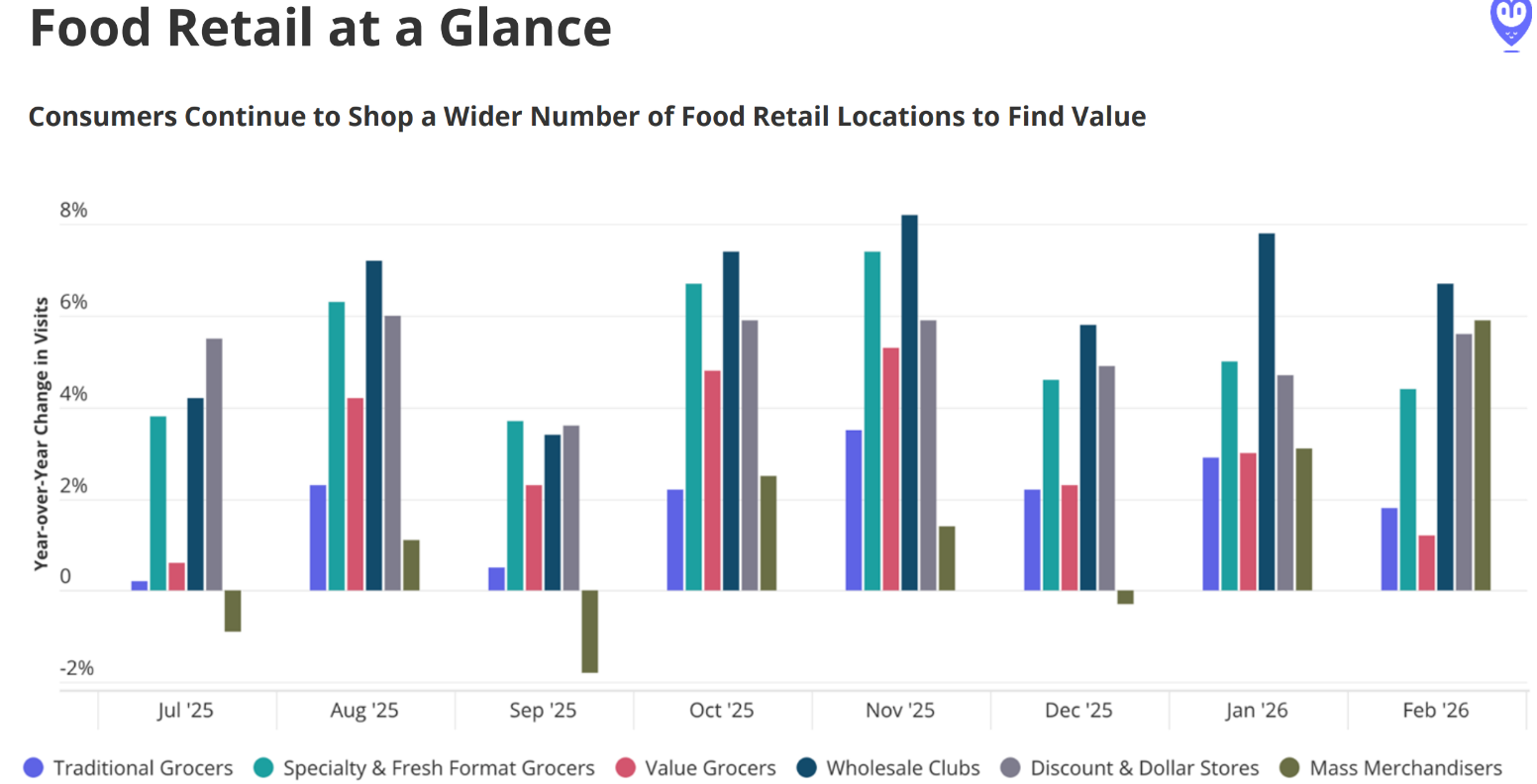
This shift in consumer behavior benefited retailers generally focused on value – especially retailers like wholesale clubs, mass merchandisers, and dollar stores.
Meanwhile, the so-called “K-shaped economy” continues to take shape, with high-income shoppers continuing to spend rather indiscriminately, which has benefitted upscale retailers.
“Underneath it all, we continue to see both (high-income and lower-income) consumers … going to more places than ever,” Hottovy noted. “You’re starting to see dwell time come down, [reflecting] more visits.
“We’ve got an interesting story going on here in terms of dwell time, and people (going) through the store much quicker than they have in the past,” said the retail expert. “We’ve seen a pretty big swing, from 2022 to 2025, in terms of the percentage [of] visits that are under 10 minutes.”
Lately, many grocery shoppers are tending to have frequent “fill-in trips,” Hottovy said. “We do see the average spend per visit is coming down, as well.” According to Placer.ai, average grocery store dwell time decreased from 24.8 minutes in 2019 to barely 23 minutes in 2025.
“I think this trend – an increase in visits, but also shorter visits – is going to continue to play [out] at least throughout the rest of this year.”
Winning Retailers
The inflationary economy has benefited the likes of fresh-format grocers and international grocers in addition to wholesale clubs (who are winning over younger cohorts like Gen Z these days).
But, more than any retail category, regional grocery chains are winning in 2026. Regional players like H-E-B in Texas and Meijer in the Midwest are especially thriving.
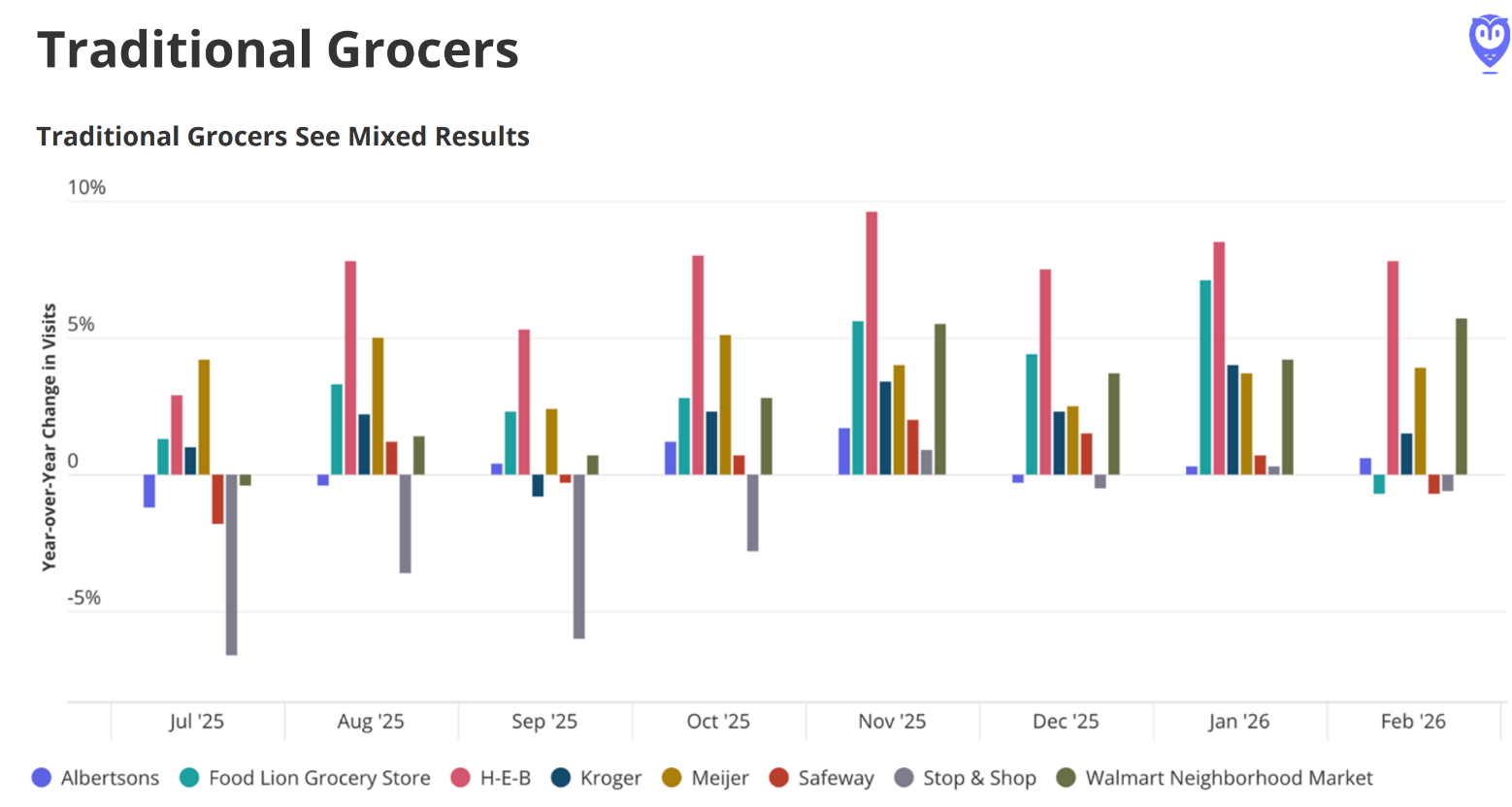
“The lesson learned is that tailoring your assortment and experience (to) that local customer can go a long way in terms of building brand loyalty – and, importantly, visit frequency,” Hottovy said. “I do think consumers, particularly in this day and age, are looking at that localized experience or assortment.
“It’s been really interesting, and exciting in a lot of cases, to see some of these regional players start to become sources of disruption across the space now.”

Winning Retail Gameplan
How can grocers stand out as shoppers are increasingly price sensitive? For starters, retailers need to offer convenience. Hottovy suggested that retailers focus on the following offerings in 2026:
- A wide array of new products
- Pre-packaged meals
- Fresh meals
- A cold bar
Retailers also, obviously, must keep up with the competition in terms of innovation, keeping an open mind with regard to technology like AI.
“There are a lot of cool things we’re starting to see in the store, whether that be retail media, whether that be new technologies (like) scan-and-go [exit] gates that we’re seeing in Sam’s Club,” Hottovy said. “We’re starting to see AI influence stores in terms of how stores are built. So, it’s going to be really interesting to watch.”
Peering Ahead
Hottovy foresees a continued, yet “reluctant” trade down to be exhibited by middle-income consumers (those with household incomes ranging from $75,000 to roughly $110,000).
Surging fuel prices only exacerbate that issue.
“I do think we’ll see consumers pull back on the channel surfing, if you will, and start to kind of refocus and consolidate that trip,” Hottovy said.
Based on historical data, he noted, if gas surpasses $4.50 per gallon, it could impact America’s shopping habits.
“If we get to that point, it could really start to change consumer behavior,” Hottovy said. “So, stay tuned on that.”
The Food Institute Podcast
While many food industry professionals were hoping that the Supreme Court ruling on tariffs would elucidate the current global trade environment, it appears that it may have added more uncertainty than before. CBIZ’s Lou Biscotti and Mark Baran, and former Customs expert Michael Contino, all join The Food Institute Podcast to provide clarity and actionable insights.