
National brands still win with Gen Z – but their lead is becoming increasingly fragile.
A study from global retail platform First Insight polled 2,151 adult consumers to find subtle consumer sentiment shifts, particularly among younger generations.
In recent years, CPG leaders have worried about losing market share, first to private label price plays, then to challenger and “insurgent” brands’ attractive value propositions and effervescent community building.
The reality is more complicated: Gen Z still prefers national brands, but they notice them less, explore them less, and treat them as interchangeable with cheaper or emerging alternatives.
When shown side-by-side photos of peanut brands across four product types (national brand, private label, DTC/subscription brand, and premium “specialty” brand), 42% of Gen Z said the national brand stood out to them first, compared to 50% of Boomers. This gap widens when the exercise is iterated for vitamins, with 27% of Gen Z choosing the national brand compared to 67% of Boomers.

This wedge tells a clear story. National brands still have shelf presence, but it’s quickly eroding. The report found that the DTC brand with no shelf “heritage” took 24% of Gen Z first-choice votes, suggesting the generation’s wandering eye makes them more interested in challenger category entrants.
“Gen Z still picks national brands when you put four options in front of them,” said Viki Zabala, chief strategy and growth officer, in a statement.
“What this data shows is that they’re noticing [national brands] less, exploring them less, and in categories like vitamins, they’re a coin flip away from choosing a challenger instead.”
This is part of an overall shift among younger generations to spend each retail dollar thoughtfully.
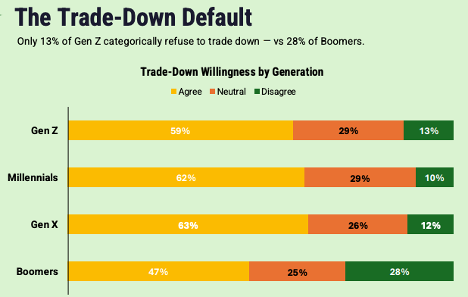
When asked about whether they’ll trade down for CPG purchases, most younger generations agreed.
‘Trading Down’ Isn’t Universal
Price as a pure motivator to trade down paints an incomplete picture. When asked about where Gen Z will shift their spending for F&B purchases, 31% said they’d save on store brands, while 21% would splurge on specialty. The gap reverses for health and wellness categories, with only 16% trading down and 25% trading up.
“Gen Z makes conscious trade-offs – saving on staples where products feel interchangeable to invest in categories tied to health, identity, and self-expression,” the report noted.
“For brands, the implication is clear: value expectations vary dramatically by category. For national brands, this means value is not about lowering price – it’s about earning prioritization.”
This shift coincides with the top purchase drivers across generations. Although price beats out quality 33% to 30% for F&B, it is far less important to health & wellness consumers.
These shifts motivate Gen Z to shop differently than other cohorts; for one, they’re frequenting dollar stores more often. They’re also more likely than Boomers to shop at specialty stores or the DTC format.
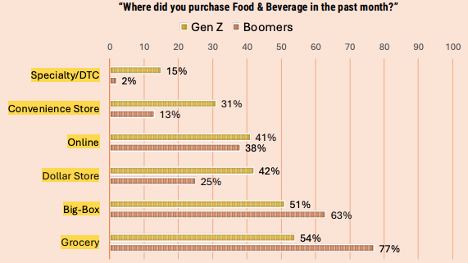
Convenience also emerged as a motivation for F&B shopping among Gen Z. Roughly 31% of the cohort shopped at convenience stores and 41% online, suggesting the growing importance of convenience-driven retail.
Moreover, younger generations are most likely to subscribe (34%) to an F&B offering, and are more open to it in the future (38%). F&B garners the highest values of all subscription types polled and compares to the 69% of Boomers not subscribing at all.
As traditional loyalty wanes, subscriptions can be a winning strategy to engage younger shoppers; however, consumers must see a clear benefit, and it must make sense for the product and brand.
Overall, findings reveal Gen Z is not a monolith. They’re mixing value, convenience, and relevance to determine where, and from whom, they buy.
The Food Institute Podcast
Chris Campbell sits down with Sharon Aho, Senior Managing Director at Korn Ferry, to discuss how food and beverage companies can navigate labor challenges, transformation initiatives, supply chain disruption, M&A activity, and the growing pressure to balance cost efficiency with talent excellence.