

America’s pizza giants have been struggling lately – from Pizza Hut’s identity crisis to Domino’s market stagnation woes – and the sector at large seems to have lost its delivery dominance.
In addition, several pizza chains filed for bankruptcy in 2025, including Pieology Pizzeria, Anthony’s Coal Fired Pizza & Wings, and Bertucci’s Brick Oven Pizza & Pasta – and California Pizza Kitchen also recently sold itself to an investor group for less than $300 million despite being sold for $470 million in 2011, when it went private, according to sources.
Even The Wall Street Journal recently claimed that America is falling out of love with pizza, but there may still be hope for pizza brands that can deliver on quality, which now tops the list of consumer priorities.
The Competition Heats Up
According to the 2026 Pizza Delivery and Carryout Report produced by Intouch Insight in collaboration with PMQ Pizza, quality has become the top driver of Delivery Overall Satisfaction (OSAT).
“Customers were far more likely to forgive a late order than a cold or off-tasting pizza. Poor food temperature had a larger negative impact on satisfaction than any other metric, including speed or friendliness,” reads the report.
This shift in priorities has sharpened the competitive edge of smaller and mid-sized pizza chains that hadn’t stood a chance against the giants in terms of delivery speed.
“Historically, large chains have dominated by winning on logistics; they are historically faster and offer real-time tracking,” said Sarah Beckett, VP of sales & marketing for Intouch Insight.
“Mid-sized players often couldn’t compete on those metrics. The study confirms that food quality stands as the most significant driver of overall satisfaction, a trend that is leveling the playing field for mid-sized chains competing against industry giants,” Beckett told FI.
Beckett cited Jet’s Pizza vs. Domino’s as an example, as the giant (Domino’s) won the race in terms of speed, with an average delivery time of 33:28, whereas the mid-sized challenger (Jet’s Pizza) was significantly slower, with an average delivery time of 46:39.
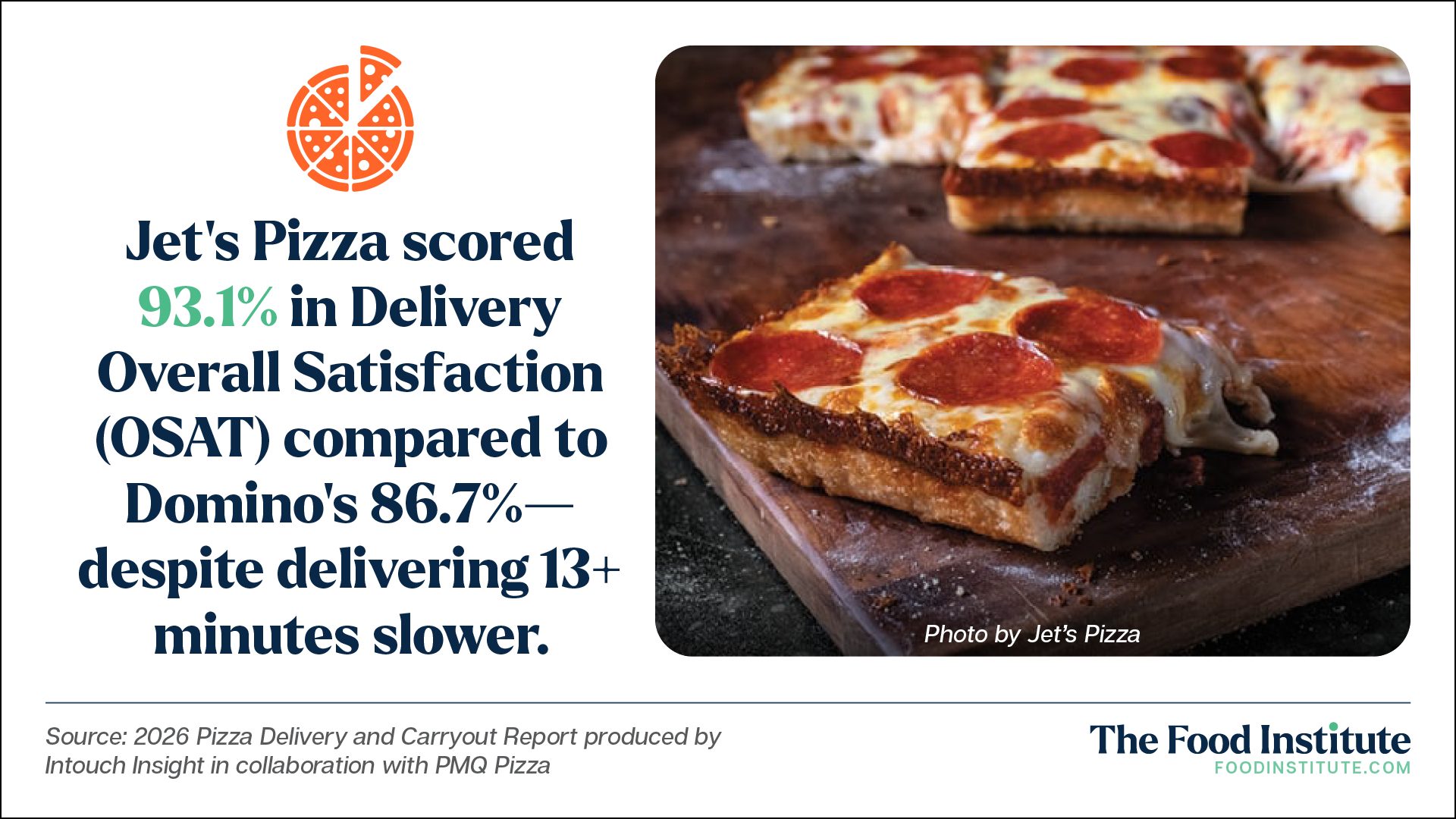
However, Jet’s achieved a higher OSAT score (93.1% compared with 86.7% for Domino’s) and a significantly higher Taste Rating (96.6% vs. 90%) despite being over 13 minutes slower on delivery.
Beckett says these mid-sized players are coming out on top largely because “the playing field has moved to their turf.”
“They can win by focusing on disciplined operational execution of the product, even if they lack the logistical speed of the giants,” added Beckett.

The Need for Speed Still Remains
Don’t take that to mean that today’s busy consumers don’t care about speed at all, though, because they definitely do.
“Speed continues to be one of the strongest drivers of the guest experience. In this year’s study, OSAT was 49.8 percentage points higher when customers were satisfied with the speed of service,” the report noted.
This is why the majority of consumers now prefer carryout over delivery.
According to research conducted by Popmenu in June 2025, 44% of diners said they prefer takeout, which allows them to bypass delivery fees and get their food faster, while 34% prefer dining in at restaurants and just 22% prefer delivery.
However, even carryout saw declines in speed last year.
“The overall carryout time increased by more than a minute year over year across the sample,” the report noted. “Seven out of 10 brands saw increases, indicating a systemwide rise in carryout fulfillment time. Marco’s, Pizza Hut, and Blaze Pizza were the only brands to reduce their total carryout time year over year.”
So, at what point do consumers start to really lose patience? According to Intouch Insight, 40 minutes tends to be the tipping point.
“Satisfied customers waited far less, while dissatisfied customers faced waits approaching an hour. The longer, the delay, the sharper the decline in sentiment,” explains the report.
One advantage the pizza giants have continued to maintain over the mid-sized challengers is the adoption of real-time tracking technology, which is correlated with better delivery performance metrics.
“Orders with tracking delivered 10.6 percentage points higher adherence to estimated times and 6.1 points higher satisfaction with speed,” the report highlighted.
