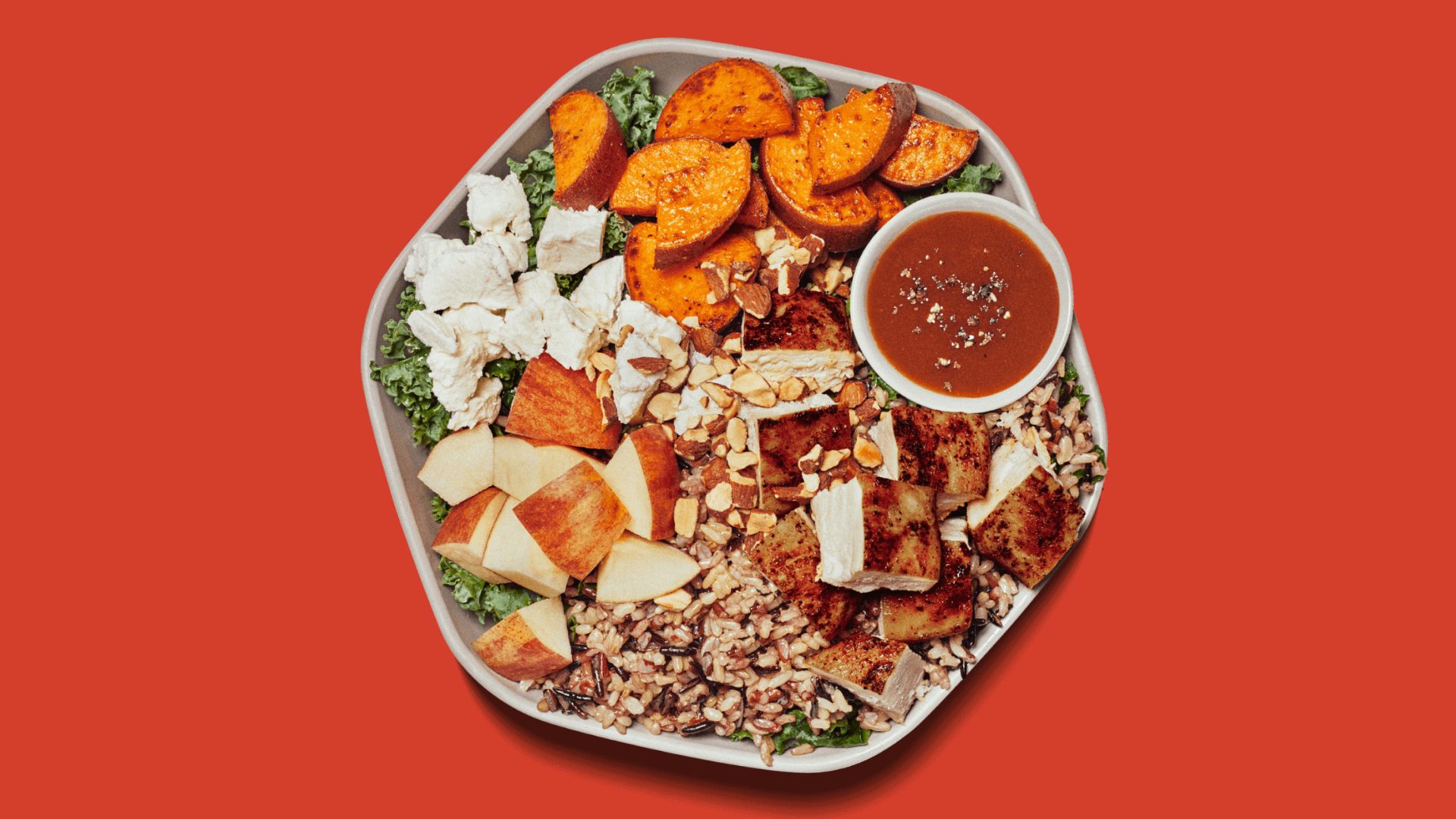
After Black Friday, I was done tracking deals … until this offer from Sweetgreen landed in my email box: ‘Tis the Seasoned $10 Harvest Bowl. My finance-savvy best friend also texted me about the deal.
When was the last time Sweetgreen did such a sweet promotion? It’s almost a 50% off discount, and it hits a psychological price threshold of $10. Years ago, when I first started working in the foodservice industry, $10 was the dividing line of an average check between a QSR and a fast-casual concept.
My friend and I decided that, on this night, dinner time would involve an order from the salad chain.
Sweetgreen has had another rough quarter. In Q3 2025, its same-store sales (SSS) declined by 9.5%. This is a steeper decline compared to its Q2 SSS decrease of 7.6%. SweetGreen’s SSS are under-performing several of its fast-casual competitors, such as Chipotle (+0.3%), Starbucks (-2%), Shake Shack (+4.9%) and CAVA (+1.9%). The salad chain’s EBITA also went from + $6.4 million in Q2 to -$4.4 million in Q3.

A Battle for Portion Size and Value
I’ve been a Sweetgreen fan since its expansion in Los Angeles. Not only because I like the food: the Harvest Bowl is my go-to order; the perfectly engineered balance of chicken and leafy greens works well for a runner like me. It’s also because Sweetgreen is one of the only salad places my kids would eat at: Little Harvest for my 9-year-old daughter, and Caramelized Garlic Steak for my son in high school.
For years, however, I’ve been in a subtle battle with my local Sweetgreen location regarding portion sizes. The fill rate seems to steadily decline. If I’m not in a hurry to get my food, I stand in line and ask a store associate for a bigger protein scoop.
To increase restaurant margins, Sweetgreen implemented its automated kitchen (the Infinite Kitchen) for precise portioning in May 2023. This coincided with noticing my Harvest Bowl filled is consistently only three-fourths of the bowl, instead of to the rim, as in the past. All my customer complaints filed with Sweetgreen’s customer service robot were about the food portion. I felt like I was getting shorted.
In Q2, CEO Jonathan Neman said on an earnings call, “We’ve made thoughtful changes to enhance our value proposition, including increasing our chicken and tofu portioning by 25%.”
Great move, Mr. Newman. But how about steaks and salmon? Those flatter bowls for the caramelized garlic steak irritate me every time I pay $19.83 (with taxes). The little harvest meal is priced at $8.55, while a Chipotle kids’ meal with a drink is under $6. Once in a while, I would get inspired by some TikTok “hack your Sweetgreen” recipe videos and try to attempt to make my own harvest bowl. But eventually I give up because, ultimately, I’d rather pay for the convenience.
Will Sweetgreen Ever Shed Its ‘Finance-Bro’ Darling Image?
When Sweetgreen launched its loyalty program in 2022, I eagerly signed up for the SweetPass+ for $10 a month. It didn’t take long for me to realize that this loyalty program was tailored for Wall Street financiers who desire a healthy lunch option, and not for a working mom whose hardest decision every day is “What’s for dinner?”
This previous loyalty program incentivized frequent visits. The perk was $3 off per order, but you could only order every 12 hours. This was not a loyalty program for moms like me, who visit 2-3 times a month but spend $60-$75 per visit to feed a family of four for dinner. I never participated in any of the health challenges as part of the loyalty program. I wanted no-frills value.
Fast-casual chains typically focus primarily on the lunch daypart. Yet, Sweetgreen’s menu options, pricing, and previous loyalty program clearly indicated they were going after a niche demographic group that wanted health and image, and mostly for lunch, and didn’t care about dollars per ounce of protein.
Sweetgreen isn’t positioned for value-conscious working moms who need to feed a family. But is that niche population–mostly men who buy lunches for themselves–a source of growth?
Apparently, SweetPass didn’t really work, which is why, in April 2025, Sweetgreen went to a points-based system, SG Rewards. I was happy to see my automatic GOAT status, though I’ve found the experience somewhat lacking. The rewards and points are only redeemable on the app, and not in-store. This little unresolved friction sits on my mind every time I redeem a free spicy chicken biscuit at my local Chick-fil-A drive-thru.
Will the $10 Harvest Bowl Work?
When I was placing the order on the app, I was again annoyed by the process; to use this discount, I had to place three separate orders for $10 each. If I simply place three harvest bowls in my cart, it would be $5 off only for the entire order, and not $10 for each bowl. It’s still surprising to me that Sweetgreen, which has built itself to be tech-savvy brand, can’t get its app right.
The other thing that befuddled me was the length of the promotion. It’s only for 7 days (Dec. 8 – Dec. 14), while Shake Shack is giving away a different free Shack sandwich with a $10 purchase each week in December; Chipotle is also rolling out a BOGO-type Unwrap Extra deal for the first three Saturdays of December.
I did, however, enjoy my recent harvest bowl dinner. So did my bestie, who ordered one for her lunch. It seems to be working among deal-savvy people. But will this week-long $10 bowl be a sustainable traffic-driving strategy that reverses the chain’s same-store sales decline? Will Sweetgreen bring this promo back if it works? It’s too hard to say at the moment. I guess we will find out at Mr. Neman’s next earnings call.
About the author: This opinion piece was written by Jinghuan Liu Tervalon, an insights, analytics and growth strategy professional with deep food and beverage industry expertise. She is a writer and runner based in Los Angeles.
Food for Thought Leadership
In this episode of Food for Thought Leadership, Food Institute VP of content and client relationships Chris Campbell sits down with Barry Thomas, senior thought leader at Kantar, to unpack the rapid rise of agentic AI — a new class of AI systems that don’t just generate information but take action on behalf of the user.