LAKEVILLE, Minn. – Outside a remodeled, suburban Pizza Hut location, SUVs screamed by on Interstate 35, barreling towards their Thanksgiving destinations. Inside the restaurant, business remained at a virtual standstill.
One of the rare remaining sit-down locations in the Pizza Hut chain, this store – located roughly 25 miles south of Minneapolis – saw minimal foot-traffic during the late afternoon hours on Nov. 26. Unlike the glory days of the 1980s, this location had no table-top video games, and no buffet. Just two TV monitors, a few booths, standard seating, and high-tops, and costlier pizzas (nearly $18 for a medium) than the chain’s main rivals.
Nostalgia is no longer present at Pizza Hut locations. And, according to many industry insiders, that’s just one of Pizza Hut’s problems these days.

Pizza Hut’s Identity Crisis
“Pizza Hut needs to re-establish a coherent value narrative, with promotions and loyalty that reinforce the brand rather than compete with it,” said Francesco Onorato, director of growth at Brandmovers.
“Domino’s has been more disciplined in its value story, consistent pricing, clear promotions, and a loyalty program that reliably gives customers something back. Their operational simplicity and investment in digital ordering make it easier for customers to get a predictable, fast experience,” Onorato told The Food Institute.
“Pizza Hut’s positioning has been less focused, making it harder for customers to know what the brand stands for today.”
Pizza Hut seemingly has been trying to turn itself around for a decade. The chain once dominated the market, but Domino’s claimed the top spot in 2017. A series of executive changes in early 2020 appeared to get the chain back on track after the COVID pandemic, but past performance has returned. Pizza Hut sales are set to decline for a second consecutive year.
The Future Hinges on Consistent Delivery
Parent-company Yum! Brands revealed in November that it has begun a strategic review of Pizza Hut that could result in a sale. That news comes amid a rough stretch for Pizza Hut, which has seen same-store sales declines for the past seven quarters, including a 6% drop in Q3 2025, as noted by Restaurant Dive.
Some industry experts feel Pizza Hut must modernize its operations in order to keep pace with competitors like Domino’s, which has especially fared well in overseas markets like India – where Domino’s operator Jubilant Foodworks nearly tripled its year-over-year quarterly profit recently.
“Pizza Hut excelled in its heyday thanks to menu options that created longer guest stays. However, the model never transitioned to successful delivery operations,” Milos Eric, the general manager of OysterLink, told FI.
“The issue to be addressed isn’t really the brand identity, but the delivery service system that they have established,” Eric said of Pizza Hut. “To get there, their menu must be simpler, and the delivery must be consistent among all their locations.”
Personalization Could Be the Secret Sauce
Experts feel Pizza Hut needs a loyalty program that personalizes offers based on individual order patterns, rather than broad discounts. Making that change could help Pizza Hut shift from “chasing transactions” to building long-term engagement, Onorato said.
“Instead of blanket discounts, the future is dynamic incentives that reward behaviors like digital ordering, larger baskets, or repeat visits, all while protecting margins,” Onorato said.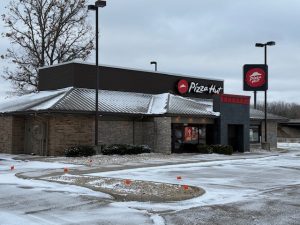
Clearly, many Americans still have a soft spot for the once-dominant Pizza Hut chain, which had more than 6,770 U.S. locations as of Nov. 3.
From L.A., to Lakeland, Fla., to Lakeville, Minn. (photographed at right), Pizza Hut continues to offer capable service and piping hot, hand-tossed pizzas. The chain simply needs to lean into selling points like value more effectively; case in point: the Lakeville location’s in-house menu doesn’t list prices – a missed opportunity when it comes to presenting a value proposition.
Considering America’s love affair with pizza, there’s still hope for Pizza Hut. But the 67-year-old chain must shift out of neutral soon, or else it risks getting passed by a growing a list of competitors, such as Little Caesars and Papa Johns.
Food for Thought Leadership
In this episode of Food for Thought Leadership, Food Institute VP of content and client relationships Chris Campbell sits down with Barry Thomas, senior thought leader at Kantar, to unpack the rapid rise of agentic AI — a new class of AI systems that don’t just generate information, but take action on behalf of the user.