Delivering a sugar bomb that appeals to Gen Z may make Dutch Bros the next big thing in the coffee sector, but experts told The Food Institute the company’s targeted approach puts it in a separate category.
With just 1,000 tiny huts serving up customizable options packed with caffeine and sugar, Dutch Bros may not be the next Starbucks. It may not even be competing with the Seattle coffee giant, which operates 40,000 outlets in 88 markets.
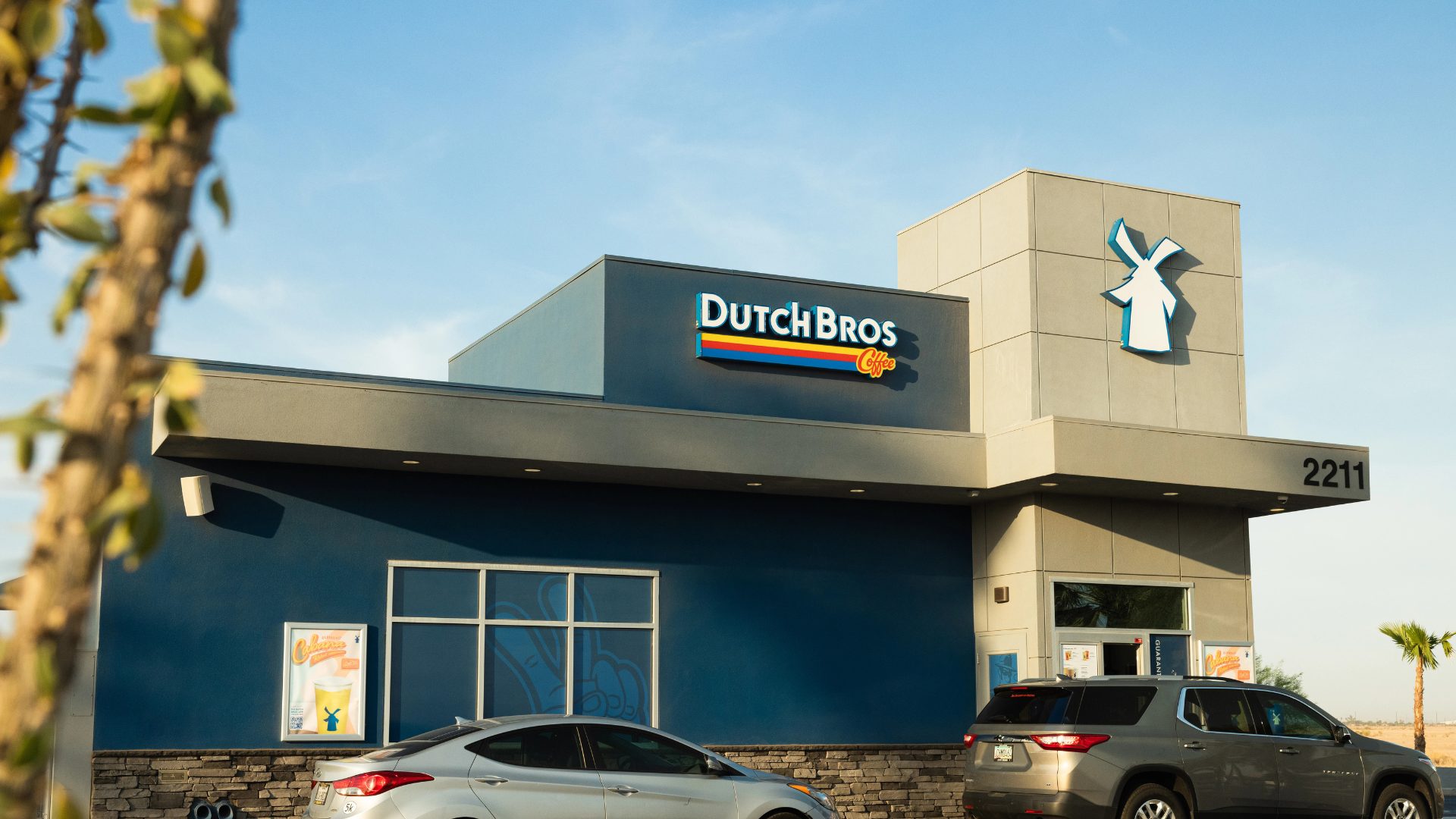
“Dutch Bros has picked their own lane, literally, with mostly drive-thru–only stands built around speed, uplifting personality, and customization that skews toward sweet and often sits in the dessert-adjacent category with caffeine,” said Michael Ashley Schulman, chief investment officer at Running Point Capital Advisors.
“Economically, (Dutch Bros’) footprint is tiny, real estate costs are low, and baristas are trained to move fast, creating a nice, repeatable cookie-cutter model for expansion.”

What started out as a pushcart-and-espresso machine operation blasting Led Zeppelin in 1992 grew to 500 stores before the company went public in 2021. Dutch Bros has since expanded to 1,000 locations, with plans to double again by 2029 and hopes for a 7,000-unit chain that stretches across the country, Bloomberg reported.
Each Dutch Bros location is no bigger than 1,000 square feet clad in gray brick and blue corrugated metal, and can be built in four months, far more quickly than their staid competitors.
The coffee chain’s founders, Dane and Travis Boersma, grew up on a dairy farm in Oregon and decided coffee should be all about the fun. Their concoctions, which also include energy drinks and lemonades, are served at the tiny huts manned by cheerful teenagers known as “broistas.”
Older chains like Starbucks claim they don’t market to Gen Alpha and Gen Z. Dutch Bros, on the other hand, wants to capture the younger crowd, packing each drink with more than 100 grams of sugar. At least one drink has 186 grams.
“They have been very centered on who they are and what they deliver to the customer,” Sharon Zackfia, a restaurant and retail analyst at William Blair & Co., told Bloomberg. “They’re having fun. That’s what they stand for.”
Kaveh Vahdat, founder and president of RiseOpp, told FI Dutch Bros’ rise highlights that growth in coffee today is less about the drink and more about the operating model.
“Starbucks scaled by creating a third place that fit how people lived and worked at the time. Dutch Bros is scaling by doing almost the opposite, removing friction, prioritizing speed, and leaning into indulgence and identity in a way that connects with younger consumers,” Vahdat said.
“The big signal here is that the traditional sit-down coffee shop is no longer the default growth model.”
The next major coffee brand is more likely to win by designing around how people behave and what they value today, he said, with convenience and emotional connection coming first.
Schulman noted Dutch Bros isn’t really competing with Starbucks.
“Its true rivals are energy drinks, quick-service indulgence brands, and the entire mini-mart ecosystem. So, on the margin, it’s fighting Dunkin’, Monster, Red Bull, and the gas station convenience store more than the neighborhood café,” Schulman said.
Bloomberg said about half the company’s sales are coffee drinks and a quarter are energy drinks. The rest are teas, lemonades and smoothies. The chain has plans to expand into prewrapped foods like muffin tops and biscuit sandwiches this year.
Food for Thought Leadership
This Episode is Sponsored by: Koelnmesse
Snacking in the U.S. has been on the rise for many years, but is this a global phenomenon? Sabine Schommer, Director, ISM, and Guido Hentschke, Director, ProSweets Cologne and ISM Ingredients, explore European and global snacking trends, and how the trio of ISM, ISM Ingredients, and ProSweets Cologne serve as a meeting place for the global snacking industry.