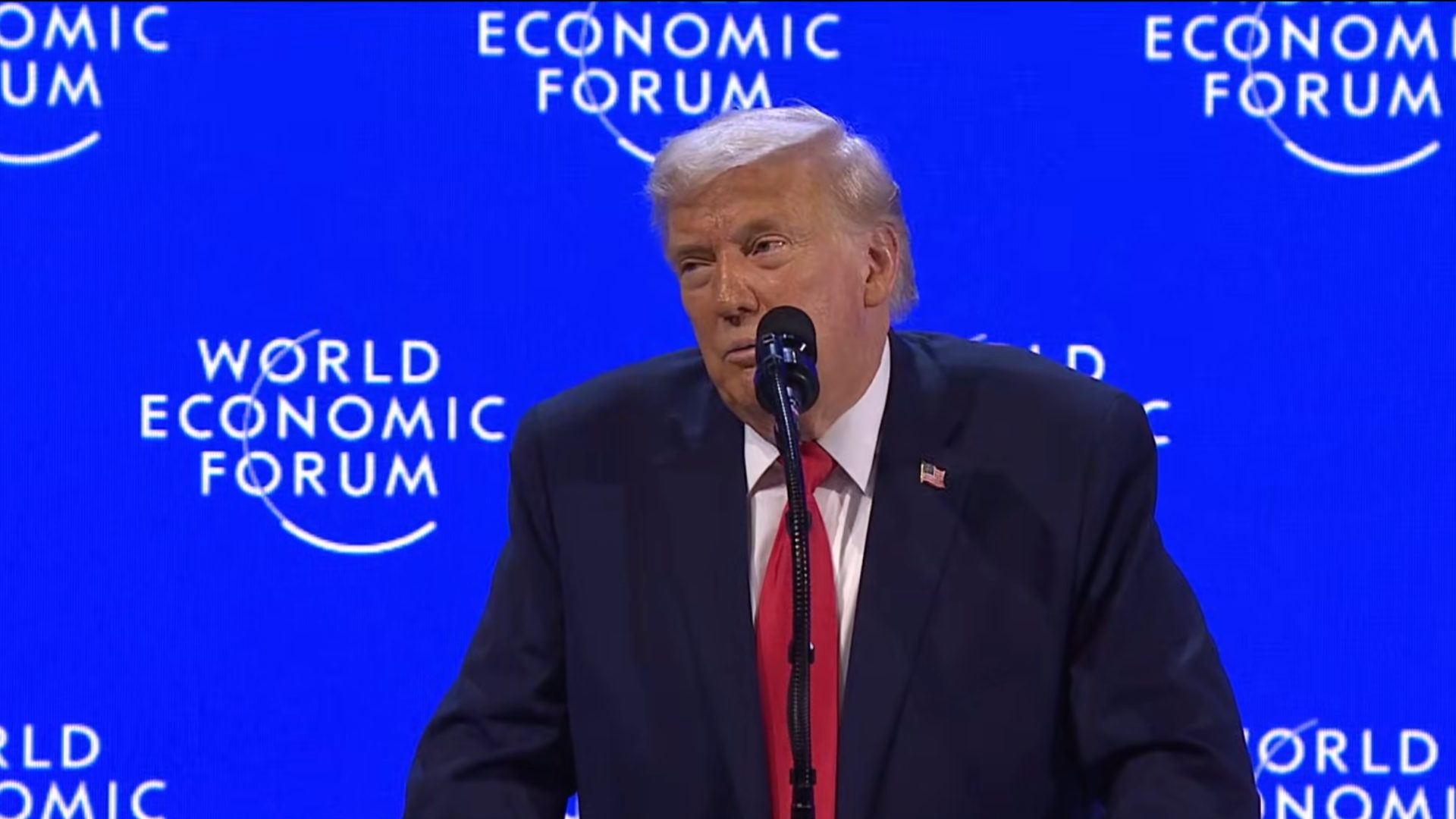
President Donald Trump took to the World Economic Forum stage in Davos, Switzerland on Wednesday to rearticulate the U.S.’s control of Greenland. Meanwhile, the European Union is considering its secret weapon — a “trade bazooka,” also known as the anti-coercion instrument (ACI).
In his speech, Trump assured that the U.S. will not use force to acquire Greenland.
He also provided a rationale for the country’s interest in the Arctic Circle region, mentioning that it is strategically located to defend against China and Russia. He assured that it would improve NATO and that U.S. development would support both European and U.S. interests.
Later Wednesday, he met with NATO Secretary General Mark Rutte and reportedly formed a framework for a deal concerning Greenland.
“We have formed the framework of a future deal with respect to Greenland and, in fact, the entire Arctic Region,” wrote the president in a Truth Social post, with the sentiment later communicated to journalists.
Trump also lifted the additional 10% tariff on eight NATO countries, previously threatened to force a deal for Greenland.
The framework is a long-term deal and a “work in progress,” Trump told Time, adding that it “gets us everything we wanted, including real national security.”
Earlier in the day, French President Emmanuel Macron took to the stage to advise allies to consider the trade bazooka, reported Euro News. European Commission President Ursula von der Leyen also made a case against Trump’s tactics.
“Plunging us into a dangerous downward spiral would only aid the very adversaries we are both so committed to keeping out of our strategic landscape. So, our response will be unflinching, united, and proportional,” she said.
Denmark has previously indicated it would not engage in negotiations to cede Greenland. Despite the conversation between Trump and Rutte, that position has not been refuted.
Before the event, Greenland Prime Minister Jens-Frederik Nielsen doubled down on the country’s position of self-governance. The country is currently a semi-autonomous territory of Denmark.

What Is the Trade Bazooka?
Established in 2021 following China’s decision to restrict trade to Lithuania over its relationship to Taiwan (which China identifies as part of its control), the package includes myriad measures to block and/or restrict trade to countries that threaten EU members.
At its most severe, the bazooka could close off access to the EU’s 450-million customer market, explained AP News. However, the source anticipates that it would take at least six months to go into effect and would likely appear in a less grievous form.
Additional measures include tariffs, restrictions on trade goods and services, limits on public program access, and modifications to intellectual property rights and direct foreign investment impacting EU countries, according to the ACI factsheet.
Recent reports suggest that many EU countries remain skeptical about whether to employ the trade bazooka in this case.
The trade value of goods and services between the E.U. and the U.S. was estimated at roughly $2 trillion in 2024, highlighting the capital at stake.
What’s Next?
Wednesday, the European Parliament protested the U.S. president’s efforts by suspending work on the EU trade deal with the U.S.
“Given the continued and escalating threats, including tariff threats against Greenland and Denmark and their European allies, we have been left with no alternative but to suspend work on the two Turnberry legislative proposals until the U.S. decides to re-engage on a path of cooperation rather than confrontation,” said committee chairman Bernd Lange, reported German public news source DW.
The open proposals would remove EU import duties on U.S. goods while continuing to offer zero duties on domestic lobsters.
Previously, the Trump administration threatened an additional 10% tariff on Denmark, France, Germany, the U.K., the Netherlands, Norway, Sweden, and Finland, which was scheduled for February 1, increasing to 25% in June, unless the U.S. is involved in a deal to purchase Greenland.
The recent conversation with Rutte signals that this is now off the table. Rutte later confirmed with journalists that the meeting was productive and that the Truth Social post provides insight into their closed-door discussions.
Trump noted that discussions will soon be held concerning a missile defense program, The Golden Dome, as well as others down the line.
In the short term, discontent between the U.S. and the EU does not bode well for domestic financial health; however, these effects will likely be short-lived. On Tuesday, the stock market experienced its worst day since October, following Trump’s original threat to impose additional tariffs: the S&P 500 closed -2.1% while the Dow Jones finished -1.8%.
In the coming weeks, negotiations between the involved countries will provide more clarity into the future of Greenland, and the impact on domestic and international business operations caught in the crossfire.
Image via Whitehouse.gov
Food for Thought Leadership
It’s undeniable that restaurants were challenged heavily in 2025, but what does that mean for 2026? Foodservice industry veteran John Inwright discusses the prospects for a new year, what’s working for successful operators, and the headwinds and tailwinds that could define the year.